Quizzes Guess the Language Quiz
Guess the Language Quiz: Can You Name All 10?
Ten lines of text, four choices each. Learn the giveaway after every one.
-
Question 1 of 10
First one's a warm-up. What language is this?
Todos los seres humanos nacen libres e iguales en dignidad y derechos.
Spanish. Los and the lone y for "and" give it away. Italian would say tutti, and French would say tous.
-
Question 2 of 10
Curly bits next to blocky signs. Which language writes like this?
すべての人間は、生まれながらにして自由であり、かつ、尊厳と権利とについて平等である。
Japanese. Those small curly bits between the blocky signs are hiragana. Chinese doesn't have them, so any curl means Japan.
-
Question 3 of 10
Cyrillic time. Name it.
Все люди рождаются свободными и равными в своем достоинстве и правах.
Russian. Look for ы, that letter like a b with a stick next to it, in свободными. Bulgarian, Serbian and Ukrainian all skip it.
-
Question 4 of 10
Math class flashback. Whose alphabet is this?
Όλοι οι άνθρωποι γεννιούνται ελεύθεροι και ίσοι στην αξιοπρέπεια και τα δικαιώματα.
Greek. You've seen π and λ on a whiteboard. The ς at the end of a word is a dead giveaway too: it's a sigma that only shows up in last place.
-
Question 5 of 10
Looks a lot like question 1. It isn't. What's this one?
Todos os seres humanos nascem livres e iguais em dignidade e direitos. São dotados de razão e consciência.
Portuguese. São and razão carry that wavy ã, and Spanish would've written los, not os. Same sentence as question 1, one border over.
-
Question 6 of 10
It reads right to left. Which language is it?
يولد جميع الناس أحرارًا متساوين في الكرامة والحقوق.
Arabic. Those joined-up letters rule out Hebrew, which keeps its letters apart. Persian and Urdu share the script, but the word الناس opens with al, Arabic's word for the.
-
Question 7 of 10
All those z's and tails. Where are we?
Wszyscy ludzie rodzą się wolni i równi pod względem swej godności i swych praw.
Polish. The tails on ą and ę are the clue. Czech and Slovak don't have them, and wsz at the front of a word is about as Polish as it gets.
-
Question 8 of 10
That odd letter ð is your clue. Who still uses it?
Hver maður er borinn frjáls og jafn öðrum að virðingu og réttindum.
Icelandic. Danish, Swedish and Norwegian dropped ð long ago. Iceland kept it, along with a lot of Old Norse, the language of the sagas.
-
Question 9 of 10
Harder Cyrillic. It isn't the one from question 3.
Всі люди народжуються вільними і рівними у своїй гідності та правах.
Ukrainian. See the dotted і, and the two dots on ї in своїй? Russian has neither of those. Ukrainian also has no ы at all.
-
Question 10 of 10
Last one, and it's the nastiest. Name this Celtic language.
Genir pawb yn rhydd ac yn gydradd â'i gilydd mewn urddas a hawliau.
Welsh. All those double d's (rhydd, gilydd, urddas) are the tell, and dd sounds like the th in this. Irish would be full of slanted accents, like á and ó.
Your score
Lost at the Airport
Every sign looks like a Wi-Fi password to you. Fine. Spot one letter per language and you'd jump five points on a retake.
Menu Reader
You'd survive a menu in Lisbon and maybe order the right soup. Cyrillic is where it fell apart, wasn't it?
Street Sign Spotter
You notice the little marks other folks skip. I bet Welsh or Ukrainian got you, and I'd bet that even at a pub quiz.
Walking Rosetta Stone
You could tell Polish from Czech on a bus ad at 40 mph. Show-off. Now try runes.
Copy your score in a fancy font
Guess the language from ten lines of text, one line per question, with four choices each. Some are gimmes. Question 10 is mean, and I'd be surprised if you got it without a Welsh cousin. After each pick you get the one letter or word that gave it away, so by the end you'll be reading foreign signs for clues without meaning to.
No audio here, and no timer. I wanted a language guessing game you could play on a bus with the sound off.
How Do You Guess a Language by Text?
Skip the words. You won't know them anyway. Hunt for the one odd letter, because almost every language keeps a mark that its neighbors don't use. I'd start here:
| If you spot this | It's probably |
|---|---|
| ñ, or an upside-down ¿ | Spanish |
| ã, õ, or words ending in -ção | Portuguese |
| ß | German |
| ą, ę, ł | Polish |
| ð and þ | Icelandic |
| å with ä and ö | Swedish |
| å with æ and ø | Danish or Norwegian |
| Double d and double l, lots of w and y | Welsh |
| Cyrillic with ы, э | Russian |
| Cyrillic with і, ї, є | Ukrainian |
| Word-final ς | Greek |
| Blocky signs with small curly kana | Japanese |
| Blocky signs and no kana | Chinese |
| Circles and little stacked blocks | Korean |
| Joined letters, right to left | Arabic, Persian or Urdu |
| Square letters, right to left, not joined | Hebrew |
Treat that as a hunch, not a court ruling. Faroese has ð too, and Turkish has ö. One letter gets you close, and a second one settles it.
Every Question Is the Same Sentence
Here's the trick I didn't tell you up top. All ten samples say the same thing: the first line of Article 1 of the Universal Declaration of Human Rights, the part about everyone being born free and equal. Accuracy was the whole reason. If I'd typed these out myself, one wrong accent in Welsh and you'd never know, and an AI writing Polish for me is exactly the sort of thing I don't trust. So each line came from a real published translation, from the UDHR text set that started at Unicode.
Two lines needed a hand. Portuguese had no ã in its first sentence, which left nothing to tell it from Spanish but one little word, so I kept the second sentence too. And the Greek file had a plain apostrophe where Ό should've been, so I put the real letter back.
Guess the Language Quiz Answers
Spoilers, obviously. Scroll past if you haven't played.
| Question | Language | The giveaway |
|---|---|---|
| 1 | Spanish | los, and y for "and" |
| 2 | Japanese | curly hiragana between the kanji |
| 3 | Russian | the letter ы |
| 4 | Greek | Greek alphabet, final ς |
| 5 | Portuguese | ã in São and razão |
| 6 | Arabic | joined letters, al for "the" |
| 7 | Polish | ą and ę, plus wsz |
| 8 | Icelandic | ð |
| 9 | Ukrainian | і and ї, no ы |
| 10 | Welsh | dd in rhydd and gilydd |
What Your Score Means
Get 0 to 3 and you're Lost at the Airport. A 4 to 6 makes you a Menu Reader, which honestly covers most of a two-week trip around Europe. Then 7 or 8 is Street Sign Spotter, and a 9 or 10 earns Walking Rosetta Stone. I'd love to meet whoever gets that without having lived in Kyiv or Swansea.
Most slips happen on the look-alike pairs, and I built them in on purpose. Questions 1 and 5 sit four apart so Spanish is still fresh when Portuguese turns up in nearly the same clothes. Questions 3 and 9 pull the same stunt with Cyrillic. Got the first of a pair and missed the second? Then you were reading the shape of the text, not the letters, and that's a normal way to get fooled by a bus sign in Lviv.
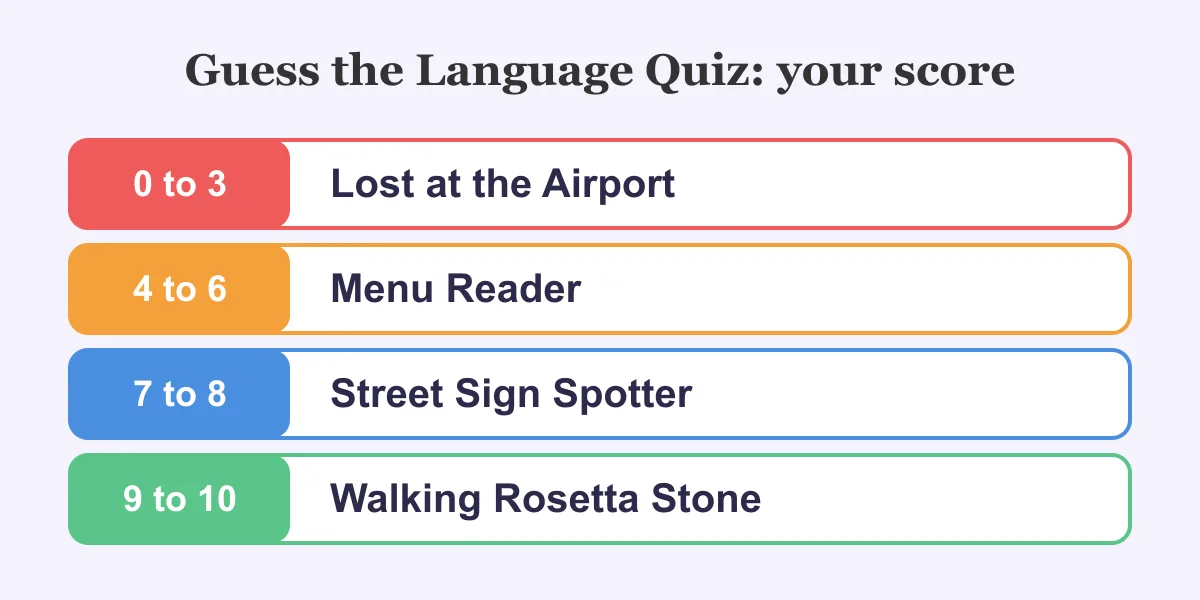
Your last screen turns the score into fancy text to paste in a bio or a group chat, and the link button dares a friend to beat it.
Where to Go After the Quiz
Stuck on Russian letters? The Cyrillic translator turns them into plain Latin letters. Japanese the problem? Try the hiragana translator first, then katakana. If question 8 made you curious, the Old Norse translator goes back to what Iceland's ð came from, and our Ancient Greek translator does the same trip for question 4.
Guess the Language Questions People Ask
Is there a guess the language game by sound? Not here. This one's text only, on purpose, so it works in a quiet office. Audio games exist, and they're a very different skill, since you get no letters to lean on.
How can I tell Japanese from Chinese? Look for curls. Japanese drops round little hiragana between its kanji, like の or は. A page with zero of those is Chinese.
How can I tell Spanish from Portuguese? Tildes, mostly. Spanish puts one on n, as in año. Portuguese puts one on a or o, as in não, and writes os where Spanish has los.
How can I tell Russian from Ukrainian? Dots. Ukrainian uses і and ї, and Russian uses neither. Russian keeps ы and э, and you won't find either one in Ukrainian.
What's the hardest language to guess by text? Scots Gaelic against Irish, if you ask me. Both love long clusters like bh and mh. The accent is the clue: Irish slants it one way, and Gaelic slants it back.
What is the most translated document in the world? The Universal Declaration of Human Rights. Guinness lists it as the record holder, and the UN counts over 500 versions, from Abkhaz to Zulu.
More to play on the quizzes page, including the Puerto Rican Slang Quiz for anyone who aced question 1.