Elvish Translator
Type English, get Tolkien's Sindarin plus a crib line for every word. Mae govannen, traveller.
AI rewrite. Click Translate or press Ctrl/Cmd+Enter. Max 800 characters. Not instant like the word-swap tools.
✨ Word-by-word gloss
✨ Real Tolkien words
✨ No signup
About This Elvish Translator
The first time this Elvish translator tried "the king is coming," it quit halfway through a word. Out came "i aran na-" with a hyphen dangling off the end, like a scribe who'd spotted an orc through the window and legged it. Not ideal if you were about to get that inked on your ribs.
So I made mine show its working, the way a fussy maths teacher would. A second line breaks down each Sindarin word, bracket by bracket. Got a scrap of Sindarin off a fan forum? Paste it. You get English.
How Do You Say Hello in Elvish?
Mae govannen. Well met. Glorfindel says it to Aragorn in the book, in Flight to the Ford, the chapter that ends with the Black Riders swept off by a flood shaped like white horses. Suilad is the quick "hiya" version. And friend? Mellon, the word the Fellowship stood outside Moria failing to guess while the Watcher in the Water got peckish.
Elvish Words, Most Useful First
Alphabetical Elvish lists bury hello somewhere after dagnir, which means slayer. Here are the sixteen my prompt reaches for, roughly in the order you'd need them.
| Sindarin | English |
|---|---|
| mae govannen | well met, hello |
| suilad | greetings |
| novaer | goodbye, be well |
| le hannon | thank you |
| mellon | friend |
| mellyn | friends |
| meleth | love |
| le melin | I love you |
| elen | star |
| ithil | moon |
| anor | sun |
| galad | light |
| estel | hope |
| aran | king |
| naur | fire |
| tolo | come |
Estel is my favourite. It's also the name Aragorn grew up with in Rivendell, which is a nice thing to call a kid.
What It Wrote, Word by Word
| English | Sindarin it wrote | Word by word |
|---|---|---|
| hello my friend | mae govannen mellon nín | mae (well) govannen (met) mellon (friend) nín (my) |
| i love you | Le melin. | le (you, polite) melin (I love) |
| thank you | le hannon | le (you) hannon (thank) |
| goodbye my friends | novaer mellyn nín | novaer (be well, goodbye), mellyn (friends), nín (my) |
| run fast, my friend, the king is coming | Noro lim, mellon nín, i aran tôl. | noro (run) lim (fast), mellon (friend) nín (my), i (the) aran (king) tôl (is coming) |
| the stars are beautiful tonight | I elenath bain sí ned dû | i (the) elenath (stars) bain (beautiful) sí (now) ned (in) dû (night) |
| I have no phone | Ú-gerin <phone> | ú (not) gerin (I have) <phone> (phone) |
Copied straight off the output box, capitals and missing full stops and all. My friend turns into mellon nín, friend first and "my" tagging along behind like a hobbit after second breakfast.
Three Things I Had to Beat Out of It
The hyphen came first. I handed the prompt tôl, which means "comes," and told it flat out: no half-words, ever. If it gets stuck, it has to leave the English in angle brackets. That's why your phone shows up as <phone>. Tolkien never wrote a word for one, and I'd rather you see the gap than get a made-up word that some forum in Ohio will laugh at.
Then tonight. The model glossed sí as "tonight," and sí doesn't mean that. It's now, or here. These days it writes sí ned dû, "now in the night," which is clunky. I'll take clunky over wrong.
Third, "I have no phone" lost its verb and came out as "im ú," roughly "me not." Caveman Elvish. Gerin, I have, is in the prompt now, and the same test comes back as Ú-gerin <phone>, which is about as close as an Elf in the Third Age could get to admitting their battery died.
My honest bit: this writes the neo-Sindarin that fans use today, built from Tolkien's real words, and the people who study his notes squabble over verb endings like dwarves over a gold cup. Birthday card, D&D campaign, a sign for your kid's bedroom door? Go for it. Permanent ink? Post the gloss on a Tolkien language forum first and wait a day.
Sindarin or Quenya?
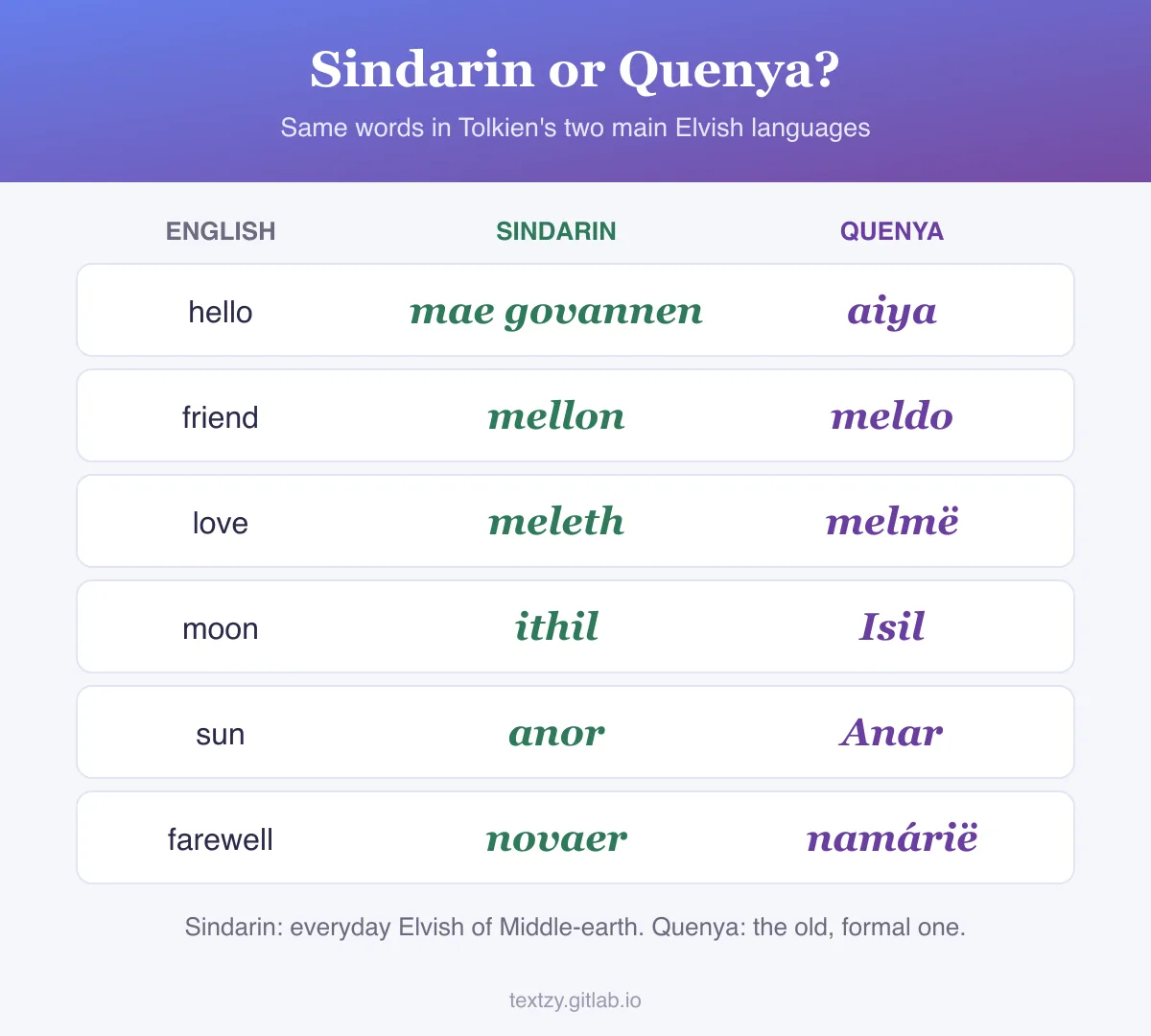
Sindarin, almost always. It's the Elvish people actually speak in Rivendell and Lothlórien. Quenya is the old, posh one, sort of church Latin for Elves, and it's what Galadriel sings in Namárië. Half the "Elvish goodbye" lists online paste Namárië in as Sindarin. It isn't.
Wikipedia's page on Sindarin has the sound changes, if you fancy checking my tool's homework.
Fun one for film fans. Arwen yelling "noro lim" at her horse? In the book that's Glorfindel's line, shouted at his horse Asfaloth with Frodo clinging on. The films swapped riders, and a linguist called David Salo wrote the rest of the Elvish for Peter Jackson's three movies, mostly from Tolkien's own scraps.
Want knights instead of elves? The Medieval Knight Translator does thee and thou with a sword. The Old English Translator gets you closer to the stuff Tolkien taught at Oxford. About forty more sit on the translators page, a few of them sillier than a Minion.
Asked at the Prancing Pony
Is Elvish a real language? Sort of. Tolkien began fiddling with it as a schoolboy. Fifty-plus years later he was still scribbling over his own verbs, and fans have been arguing about the gaps since 1973.
How do you say friend in Elvish? Mellon. Plural, mellyn. Took Gandalf a while too, and he had a staff.
How do you say love in Elvish? Meleth. "I love you" is le melin, two words, which fits nicely inside a wedding ring.
Is this the Elvish from D&D? Nope. D&D has its own Elvish with its own script. Plenty of players still nick Tolkien's for their elf's lines, and their DM rarely notices.
What's the difference between Sindarin and Quenya? Street versus church. Hello is mae govannen in Sindarin and aiya in Quenya, and you'd only use aiya to greet a star.