English to Old Norse Translator
Real lines from the Eddas and rune sticks come out exactly as written. Every other word is checked in Wiktionary's Old Norse dictionary.
AI rewrite. Click Translate or press Ctrl/Cmd+Enter. Max 800 characters. Not instant like the word-swap tools.
✨ Real Viking-age lines
✨ Works without þ and ǫ
✨ No AI guessing
About This English to Old Norse Translator
Skip the AI on this one. This English to Old Norse translator pulls every word from Wiktionary's Old Norse dictionary, 11,403 entries when I counted on 23 October 2026, each with its full table of endings. The phrases are real lines, from Hávamál, Vǫluspá and a love note scratched into a stick of wood in Bergen around 1185. No entry? Your English word comes back in brackets. Type pizza and you'll get <pizza> back. Fair enough. Bergen had no pizza in 1185.
How Do You Say I Love You in Old Norse?
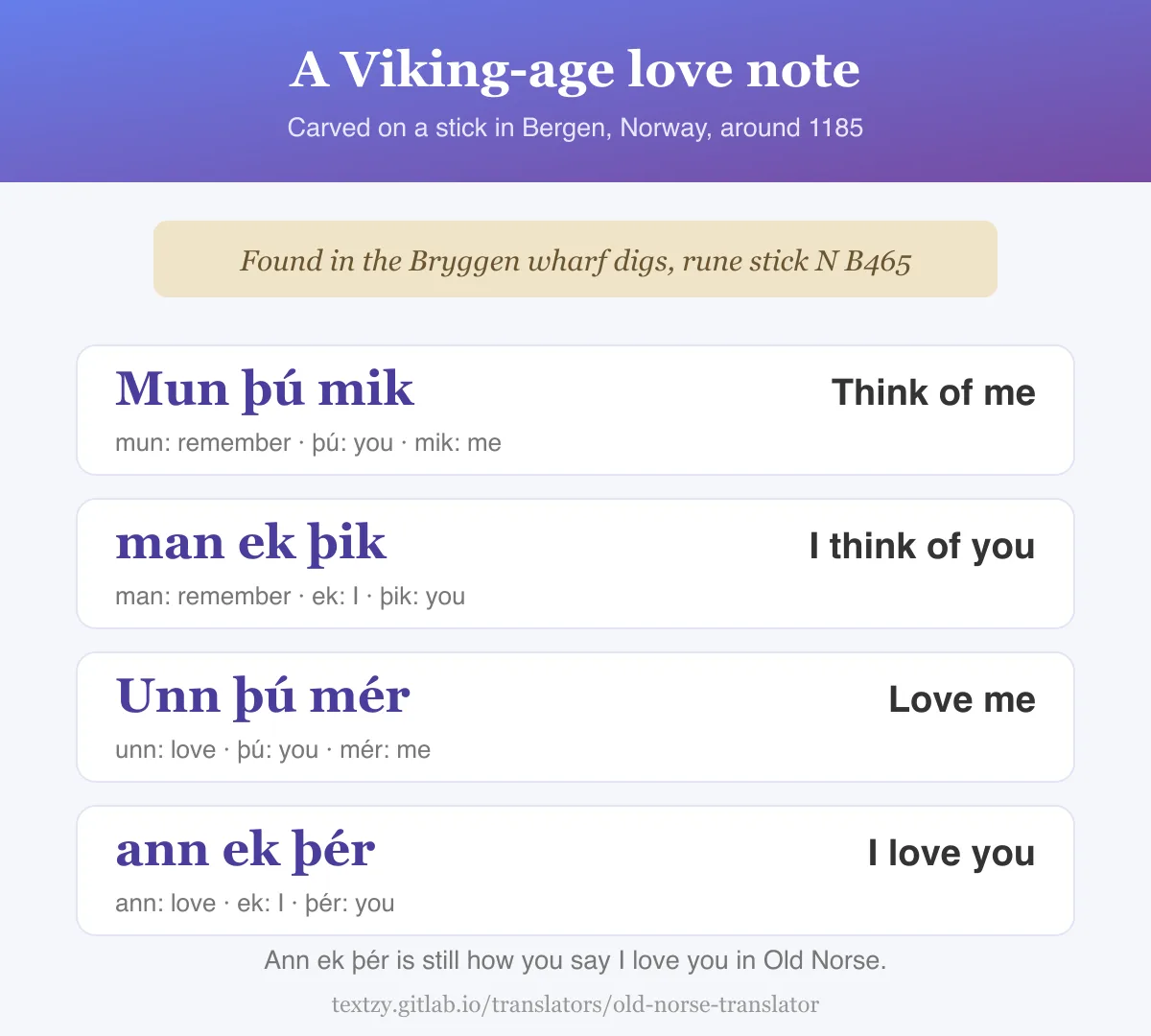
Ann ek þér. Take it apart. Ann is love, from the verb unna. Ek is I. Þér is you, in the form that receives the love. The word order isn't tidy English, and that's fine. Somebody in Bergen carved it into a little stick about 840 years ago, and archaeologists dug it out of the Bryggen wharf along with hundreds of other rune sticks, plenty of them merchants' name tags. The whole note runs "Mun þú mik, man ek þik. Unn þú mér, ann ek þér." Wiktionary's English uses thee: love me, I love thee. Fits a note carved thirty years before Magna Carta.
Lines From the Eddas, Exactly as Written
Accents stay on. Hávamál? Odin's advice, in verse. Vǫluspá? A seeress telling the gods how the world ends, which they take about as well as you'd expect.
| English | Old Norse | Where it's from |
|---|---|---|
| Hello (may you be hale) | Heill sé þú | Wiktionary, heill |
| Goodbye, good luck | Heill ok sæll | Wiktionary, heill ok sæll |
| I love you | Ann ek þér | Bryggen rune stick, Bergen |
| Cattle die, kinsmen die | Deyr fé, deyja frændr | Hávamál, verse 76 |
| But fame never dies | En orðstírr deyr aldregi | Hávamál, verse 76 |
| I know one that never dies | Ek veit einn at aldri deyr | Hávamál, verse 77 |
| I hung on a windy tree | Veit ek, at ek hekk vindga meiði á | Hávamál, verse 138 |
| Never laugh at a grey-haired sage | At hárum þul hlæ þú aldrigi | Hávamál, verse 135 |
| I remember giants born long ago | Ek man jǫtna ár um borna | Vǫluspá, verse 2 |
| Axe-age, sword-age | Skeggöld, skálmöld | Vǫluspá, verse 46 |
| There comes the dark dragon flying | Þar kømr inn dimmi dreki fljúgandi | Vǫluspá |
| Hail the day! | Heill dagr! | Sigrdrífumál |
| Odin owns the earls who fall in battle | Óðinn á jarla, þá er í val falla | Hárbarðsljóð, verse 24 |
Verse 76 is the one people tattoo. Your cows go, your cousins go, you go. Your name, if it was a good one, sticks around. Thank you is the odd one out. No old poem I could find says it, so þakka þér is put together by the rules, the same way a saga writes "she thanked him." I'd rather tell you that than pretend.
The Friend Who Was Really a Cousin
Here's the bug I caught while testing. I pasted the Hávamál line back in to check the Old Norse to English side, and frændr came back as "a friend." Wiktionary does list friend first. In verse 76, though, the word means kinsmen, the family you'd bury. So now any word the English side uses reads back with the meaning I picked it for, and frændr says kinsman. Small fix. On a line about death, it matters.
No þ on your keyboard? Most don't have one. Type th, d for ð, o for ǫ, forget the accents, and deyr fe deyja fraendr still finds verse 76.
Why Skál Comes Back as Bowl
Everyone tries skál first. Bowl. Or a pair of scales. That's what the dictionary says and that's what you get back, sorry to every brewery logo out there. The saga toast is minni. Somebody stands, names a god or a dead kinsman, drinks, and the horn goes down the bench to the next guy, who's usually had plenty already.
| English | Old Norse |
|---|---|
| Viking | Víkingr |
| Berserker | Berserkr |
| Valkyrie | Valkyrja |
| Earl | Jarl |
| Poet | Skald |
| Hall | Hǫll |
| Mead | Mjǫðr |
| Axe | Øx |
| Shield | Skjǫldr |
| Fame | Orðstírr |
| Fate | Ørlǫg |
| Rune, secret | Rún |
Rún is my favorite. Rune, and also secret. Same word. Says a lot about who got to read back then.
Sentences outside the phrasebook come out as dictionary words in your order. My brother is a strong warrior gives mínn bróðir vera sterkr rekkr, with a note that the endings aren't on. Snorri would wince. Half those words need different endings. Every one is a real dictionary word, though, so a tattoo artist in Oslo can look each one up before the needle comes out and nobody walks home with a typo.
Þ is the th in thin. Ð is the th in this. Ǫ? Round your lips and say the o in pot. Accented vowels get held, so ást, love, comes out long, like the a in father.
The High Valyrian Language Translator is built the same way, if Westeros is more your thing. Beowulf more your speed? Modern English to Old English. More made-up and long-dead tongues wait on the translators page. Every word here can be checked in Wiktionary's Old Norse dictionary.
Old Norse, Answered
Can Google Translate do Old Norse? No. Its list has Icelandic and stops there. Set it to Icelandic, paste Hávamál, and you'll get a guess built on 800 years of spelling changes, which is not what you want on a tattoo you'll be showing people at the beach for decades.
How do you say hello in Old Norse? Heill sé þú, may you be hale. Heill on its own is closer to hail. That's how Sigrdrífa greets the morning in her poem: heill dagr.
Did Vikings speak Old Norse? Yes. They called it dǫnsk tunga, the Danish tongue, even in Norway and Iceland. English still has their words for sky, egg and knife.
Is Old Norse the same as Icelandic? Close, not the same. Icelandic kept most of the old grammar, so a saga is hard work there but doable. The ǫ letter got dropped from the spelling long ago.
What does skál mean in Old Norse? Bowl, and sometimes a pair of scales. A toast at a feast was a minni, drunk in memory of someone.
What is the most accurate Old Norse translator? For real lines? One that copies the sources letter for letter, which this one does. New sentences are a different fight. Anything that adds endings for you is guessing, and this tool would rather hand you plain dictionary words and admit it.