Cuneiform Translator
Type English, get cuneiform signs to copy. Paste cuneiform, get the reading.
AI rewrite. Click Translate or press Ctrl/Cmd+Enter. Max 800 characters. Not instant like the word-swap tools.
✨ Works both ways
✨ Real syllable signs
✨ No signup
About This Cuneiform Translator
Plenty of converters out there give every English letter its own wedge, picked more or less at random, and leave you to it. No scribe in Babylon ever wrote like that. This cuneiform translator works by syllable instead, with signs Akkadian and Hittite writers pressed into actual clay. Type English and you'll get signs to copy. Paste signs and you'll get the reading back, with a dash between syllables, the way experts write it.
Is Cuneiform an Alphabet?
No, and that's the part most charts get wrong. A scribe had one sign for ba, another for bi and another for ab, plus hundreds of signs that stood for whole words. Spelling was loose, too, and the syllable gu alone could be written with fourteen different signs, depending on where and when the scribe happened to be working. The one true cuneiform alphabet came from Ugarit, in Syria, around 1400 BC. It had 30 letters and was dug up in 1928, and it's a different script from the one this tool writes.
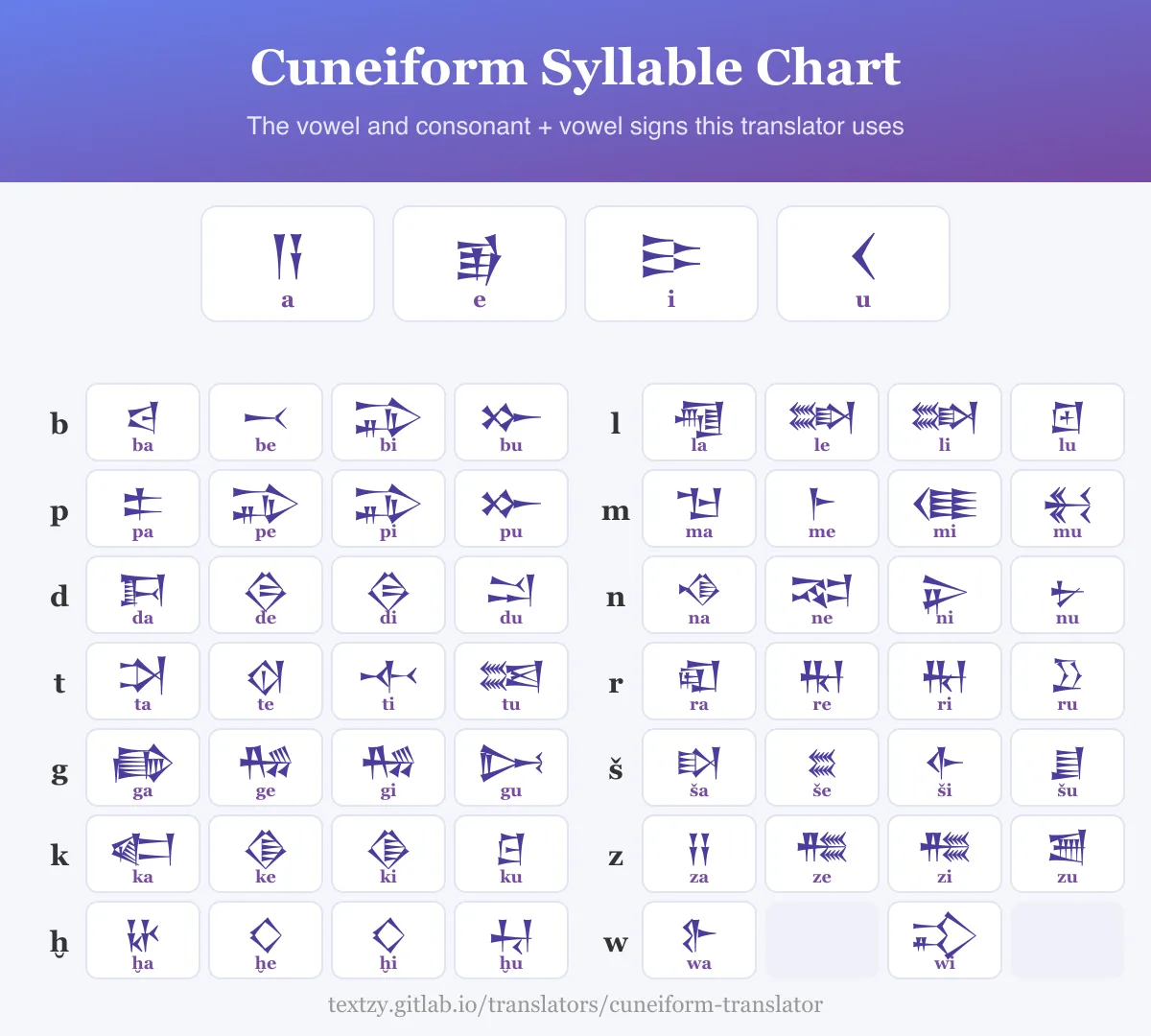
So a cuneiform alphabet chart from A to Z only works if each letter turns into a sound first. Here's what every letter becomes before the tool picks a sign. Consonants are shown with an a after them, since a sign is always a full syllable.
| Letter | Sound | Sign |
|---|---|---|
| A | a | 𒀀 |
| B | ba | 𒁀 |
| C | ka, or ša before e, i and y | 𒅗 |
| D | da | 𒁕 |
| E | e | 𒂊 |
| F | pa, since there's no f | 𒉺 |
| G | ga | 𒂵 |
| H | ḫa, silent after a vowel | 𒄩 |
| I | i | 𒄿 |
| J | ya | 𒅀 |
| K | ka | 𒅗 |
| L | la | 𒆷 |
| M | ma | 𒈠 |
| N | na | 𒈾 |
| O | u, since there's no o | 𒌋 |
| P | pa | 𒉺 |
| Q | ka, and qu is k plus w | 𒅗 |
| R | ra | 𒊏 |
| S | ša | 𒊭 |
| T | ta | 𒋫 |
| U | u | 𒌋 |
| V | wa before a vowel, b after one | 𒉿 |
| W | wa | 𒉿 |
| X | ka plus ša | 𒅗𒊭 |
| Y | ya before a vowel, i otherwise | 𒅀 |
| Z | za | 𒍝 |
Akkadian got by on four vowels, and it had no o at all, with f and v missing too, so those letters grab whatever sound sits nearest. Hittite scribes dropped the separate s signs and wrote s with the š set, which sounds like sh, and the tool does the same. Capitals vanish, since cuneiform didn't have any. Numbers and commas? Left alone.
How Do You Translate English Into Cuneiform?
Three passes, one after another. First your spelling gets sounded out, more or less, which means Grace drops its silent e and its c goes soft. Next come the syllables. A consonant sitting in front of a vowel teams up with it (ba), while one sitting after a vowel shuts it (ab). For the last pass it looks up each piece in the syllable list Hittite scribes borrowed from Akkadian, which is the same table Wikipedia prints in its article on Hittite cuneiform. That's how Sam becomes ša-am. You'll see the a twice, but you only say it once, and scribes wrote plenty of words exactly that way.
Checked Against Hammurabi's Own Name
The best test is a name scribes really wrote. Hammurabi was king of Babylon. Clay documents written while he sat on the throne spell him ḫa-am-mu-ra-bi. I typed Hammurabi into the box and got 𒄩𒄠𒈬𒊏𒁉, and when I held that up against the signs Wikipedia shows for his name, they're the same five, in the same order, with nothing added. The ḫ is a rough throat sound, like the ch in loch. The double m becomes am-mu, which is how scribes showed a doubled consonant.
| English | Tool output | Pasted back |
|---|---|---|
| Hammurabi | 𒄩𒄠𒈬𒊏𒁉 | ḫa-am-mu-ra-bi |
| Sam | 𒊭𒄠 | ša-am |
| Anna | 𒀭𒈾 | an-na |
| Sarah | 𒊭𒊏 | ša-ra |
| Emily | 𒂊𒈪𒇷 | e-mi-li |
| Liam | 𒇷𒄠 | li-am |
| Babylon | 𒁀𒁉𒇻𒌦 | ba-bi-lu-un |
| Uruk | 𒌋𒊒𒊌 | u-ru-uk |
| Marduk | 𒈠𒅈𒁺𒊌 | ma-ar-du-uk |
| love | 𒇻𒌒 | lu-ub |
Where It Trips
English spelling is a mess, and the tool only sees spelling. Michael gets a sh sound, because ch means sh here unless an r or l comes next, as in Chris. John turns into i-un, since there's no sign for jo. Andrew has three consonants in a row, which Akkadian never allowed, so it picks up extra vowels and comes back as an-di-ri. Going backwards loses detail as well, because some sounds share a single sign, so pe and pi both come back as bi and Sophia returns as šu-bi-a. If a name's spelling is odd, type it the way it sounds.
How Was Cuneiform First Translated?
By people checking each other's homework, which I love. By 1851, Edward Hincks and Henry Rawlinson could read 200 Akkadian signs. In 1857 the Royal Asiatic Society handed a newly found inscription of the Assyrian king Tiglath-Pileser I to four scholars, Hincks, Rawlinson, Julius Oppert and William Henry Fox Talbot, and each one worked on it alone. A jury compared the four versions and found they agreed on all the main points. Talbot, the newest of the four, made the most mistakes.
Where I'd Use It, and Where I Wouldn't
A name plaque for a history class or a clay tablet craft? Go for it. It won't translate into the Akkadian language, though. Type love and you get the English word dressed up in old signs, while an Akkadian speaker would've used a different word entirely. Thinking of a tattoo? Get someone who reads Akkadian to look first. Your browser's font also draws the early Sumerian shapes, which aren't the ones a Babylonian scribe would've pressed into a tablet centuries later.
Into other old scripts? The Egyptian Hieroglyphics Translator spells names in real signs, and the Rune Translator does the Viking side of things. You'll find the rest, the silly ones included, on the translators page. For the full sign list, the Hittite cuneiform article on Wikipedia is the one I used.
Cuneiform Questions, Answered
Can cuneiform be translated? Yes. Experts have been reading Akkadian since the 1850s. My box is far less ambitious. It spells English sounds with cuneiform signs, then reads them back.
How do you translate cuneiform to English? Paste the signs in. Each sign it knows becomes its syllable, with dashes in between. Signs it doesn't know, like the ones for whole words, stay just as you pasted them.
How do I write my name in cuneiform? Type it in, hit copy, done. Got a name that's spelled one way and said another, like Sean? Spell it how it sounds, so Shawn.
Was there ever a cuneiform alphabet? Yes, one. Scribes at Ugarit, on the Syrian coast, pressed a 30-letter alphabet into clay. Everywhere else kept cuneiform as a jumble of syllables and word signs.
Why does Sam have two a's? Each sign is a whole syllable, so a closed syllable like sam is written ša plus am. The vowel shows twice but is said once.
Does it write cuneiform numbers? No. Digits pass through untouched. The sign for 10 is the same wedge as the syllable u, and 30 is the same as eš, so mixing them in would break reading the signs back.