Binary Translator
Ones and zeros while you type. Or paste a T-shirt's worth of binary back in for the words.
AI rewrite. Click Translate or press Ctrl/Cmd+Enter. Max 800 characters. Not instant like the word-swap tools.
✨ Text to binary and back
✨ Emoji and accents
✨ No signup
About This Binary Translator
Nerdy T-shirts are what this binary translator is really for. Some guy at the gate in Denver has a wall of ones and zeros across his chest, and you spend the whole boarding queue wondering if it's rude. Paste it in here and find out. Type words instead and you get the ones and zeros back.
How Do You Read Binary Code?
It's read eight digits at a time, and each group of eight is one letter. Think of the eight spots as price tags: 128, 64, 32, 16, 8, 4, 2, 1. Wherever there's a 1, you pay that much. 01001000 costs 64 plus 8, so 72, and on the ASCII chart 72 is a capital H. The card below draws it out, because my words alone never stick.
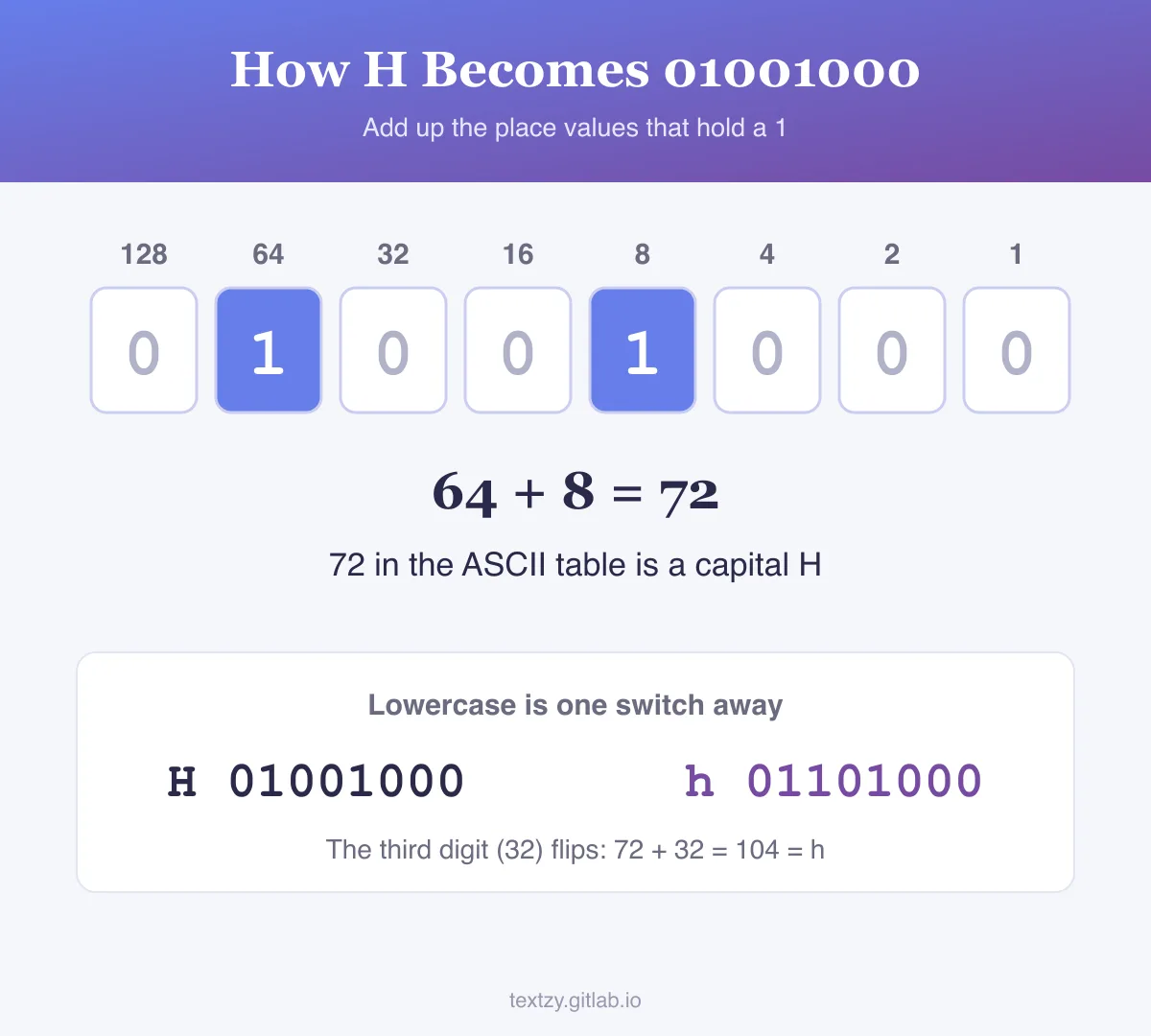
Lowercase letters sit 32 above their capitals. Some committee picked that in the early sixties, and programmers have been quietly grateful ever since.
The Annoying Decision
I wrote the engine for this one myself. No AI in it. And the hard part wasn't the maths at all. It was guessing which way you meant. One box, no switch. So how does it know?
My rule: if what you paste is nothing but 0s, 1s and spaces, at least eight digits long, it reads it as binary. Anything else gets turned into binary. That works almost always. But type 101 and you get the binary for the characters 1, 0 and 1, three whole bytes, because three digits can't make a byte. I went back and forth on that and left it, since someone typing "101" is more likely writing about a class than sending a secret code.
Then there's junk. Paste 10101010 by itself and you'll see a little "�" box. That byte is only ever the middle of a longer character, like a single puzzle piece from a box you don't own. I'd rather show you the box than make up a letter.
Spaces barely matter on the way back. Squash it all into one long line (0110100001101001) and it chops it into eights and still reads "hi."
Letters and a Few Words
| Character | Binary |
|---|---|
| A | 01000001 |
| a | 01100001 |
| H | 01001000 |
| h | 01101000 |
| I | 01001001 |
| i | 01101001 |
| Z | 01011010 |
| z | 01111010 |
| 0 | 00110000 |
| space | 00100000 |
| ! | 00100001 |
| hi | 01101000 01101001 |
Yep, the gap between words costs a full byte too.
The Heart That Ate Six Bytes
Plain English letters cost one byte each. Everything else goes through UTF-8, the system nearly every website uses for text now, and that's where it gets greedy. An é takes two bytes. The crying-laughing emoji takes four.
That red heart caught me out when I tested it. Six bytes! Turns out it's two characters glued together, an old black heart plus an invisible tag telling your phone "paint this red." A binary love letter stuffed with hearts gets long fast, so maybe go easy.
A Placemat and a Philosopher
Gottfried Leibniz wrote binary up in 1703 for the French Academy of Sciences. A Jesuit pen pal working in China, Joachim Bouvet, had mailed him diagrams from the old I Ching, and Leibniz spotted his own ones and zeros hiding in the broken and solid lines. He was thrilled. Years before, he'd even sketched a medal for a duke to celebrate it, a little sun shining over rows of digits. Nobody ever struck it. He had no computer, just a quill and a very big idea.
Fast forward to 1963, when ASCII fixed which number means which letter, so a Teletype from one firm could finally read text from another. Then, one evening in 1992, Ken Thompson and Rob Pike scribbled UTF-8 on a placemat in a New Jersey diner. Every emoji in your texts rides on that placemat.
Codes are kind of my thing. The Morse Code Translator turns you into dots and dashes, and the Leet Speak Translator gets you 1337. There's a lot more on the translators page.
Ones and Zeros, Answered
How do you translate binary to English? Paste it. Without the tool you're back to price tags: chop it into eights, total up each one, then find each total on an ASCII chart. Slow, but it works on a train with no signal.
What is hello in binary? 01101000 01100101 01101100 01101100 01101111, all lowercase. Two of those bytes are the same, thanks to the double L.
How do you say I love you in binary? 01001001 00100000 01101100 01101111 01110110 01100101 00100000 01111001 01101111 01110101. Ten bytes, gaps included, which fits on a mug if the mug's big.
Can it turn binary into numbers? Nope, words only. 00110001 comes out as the character 1, even though the byte is worth 49. For the number, your phone's calculator has a programmer mode tucked away.
Why are there 8 digits in each group? Blame IBM. Its 1964 System/360 went with eight, and the rest of the industry trailed after it like ducklings.