Egyptian Hieroglyphics Translator
Names in, scribe signs out. Paste signs back to hear them.
AI rewrite. Click Translate or press Ctrl/Cmd+Enter. Max 800 characters. Not instant like the word-swap tools.
✨ Real Unicode hieroglyphs
✨ Egyptian numbers
✨ No signup
About This Egyptian Hieroglyphics Translator
Cleopatra takes nine signs in this Egyptian hieroglyphics translator. A vulture in the middle, another at the end, which seems like a lot of vulture for one queen. Type a name for the signs, English to hieroglyphics. Paste signs for the sounds, hieroglyphics to English.
How Do You Write Your Name in Hieroglyphics?
Sound it out, one sign per sound. Scribes kept about two dozen signs for single sounds, mostly for spelling foreign names, and museum charts borrowed that set for English. Sam gets a folded cloth, a vulture and an owl. The tool spells letter by letter, though, so Phil gets a stool for the P. A scribe would've heard an F and drawn the viper. Type Fil if you want his version.
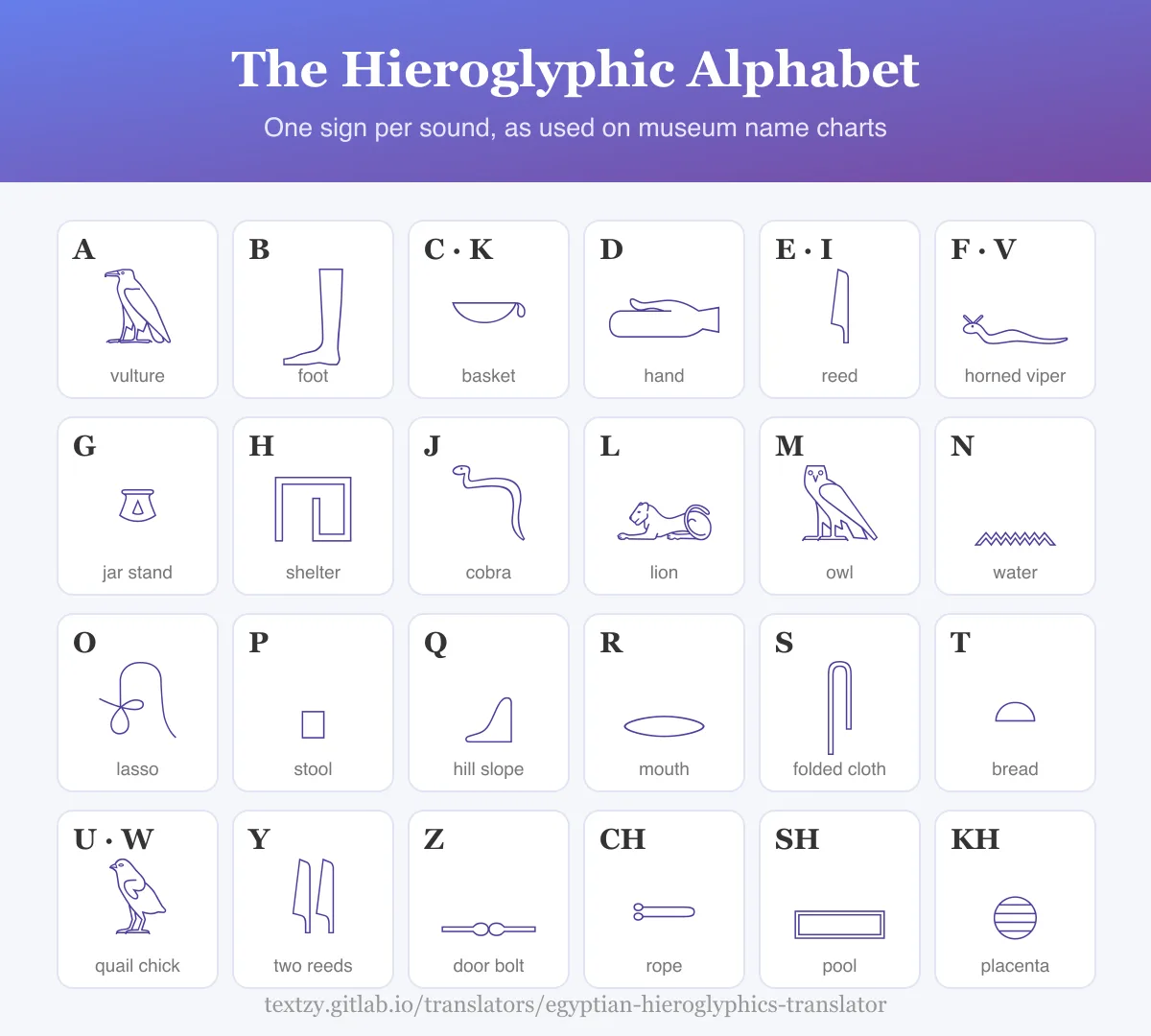
The Hieroglyphic Alphabet, Copy and Paste
I checked every sign here against its official Unicode name, G17 for the owl and so on, before letting the tool use it. The codes are Gardiner's. He was a British Egyptologist, and he numbered them in a 1927 grammar book that's still the one students lug around, which is why the owl is G17 in a museum catalogue and on your phone alike. See empty boxes? Your phone's missing the font. The birds are still in there.
| Letter | Sign | What it shows |
|---|---|---|
| A | 𓄿 | Egyptian vulture (G1) |
| B | 𓃀 | foot (D58) |
| C, K | 𓎡 | basket with handle (V31) |
| D | 𓂧 | hand (D46) |
| E, I | 𓇋 | flowering reed (M17) |
| F, V | 𓆑 | horned viper (I9) |
| G | 𓎼 | jar stand (W11) |
| H | 𓉔 | reed shelter (O4) |
| J | 𓆓 | cobra (I10) |
| L | 𓃭 | lion (E23) |
| M | 𓅓 | owl (G17) |
| N | 𓈖 | water (N35) |
| O | 𓍯 | lasso (V4) |
| P | 𓊪 | stool (Q3) |
| Q | 𓈎 | hill slope (N29) |
| R | 𓂋 | mouth (D21) |
| S | 𓋴 | folded cloth (S29) |
| T | 𓏏 | loaf of bread (X1) |
| U, W | 𓅱 | quail chick (G43) |
| X | 𓎡𓋴 | basket and cloth, K plus S |
| Y | 𓇌 | two reeds (M17A) |
| Z | 𓊃 | door bolt (O34) |
| CH | 𓍿 | tethering rope (V13) |
| SH | 𓈙 | pool (N37) |
| KH | 𓐍 | placenta (Aa1) |
The lion for L is a borrowing. Old Egyptian had no real L sound, so scribes reached for the lion when they had to write foreign names like Cleopatra and Ptolemy, and that's the one modern charts kept.
The Christina Problem
Christina gets a rope. Blame the letters. CH is the rope sign on every museum chart, which works for Chad and Charlotte, and the tool has no idea her CH is really a K. I'd rather match the charts than guess. Type Kristina and the basket turns up. Chloe and Christopher have the same problem, and so does Chris, so spell any of them with a K if the rope on the front of the name bugs you.
Numbers weren't simple either. No zero, no place values. You just pile them up: strokes for ones, heel bones for tens, rope coils for hundreds, lotus flowers for thousands. A million gets a little kneeling god throwing his arms up, which is roughly how I feel about a million too. 2026 is two lotuses, two heel bones and six strokes, and the tool counts them back up when you paste them in, so you can check a date off a museum photo without doing the sums on your fingers.
What It Won't Do
Sounds only. Real Middle Egyptian, the language on temple walls, needs grammar no code tool can fake. Type cat and you'll get C, A, T in signs. The real Egyptian word was miu, which, fine, is just a meow written down. It won't draw the oval cartouche around your name either. Copy the signs and add the loop yourself on paper with a pencil, or wrap them in a pair of brackets when they go into an Instagram or TikTok bio.
Reading back isn't perfect either. E and I share a reed, U and W share a chick, so 𓇋 comes back as i every time. You'll get the sounds right. Pick the spelling yourself. Scribes' readers had to as well. Paste a name someone else wrote and say it out loud first.
Into codes? The Braille Translator and the Binary Translator both work both ways, and there's a whole shelf on the translators page. The Egyptian hieroglyphs page on Wikipedia has the whole 3,500-year story.
Hieroglyphics, Answered
Can you translate hieroglyphics to English? The sounds, yes. Paste signs from the alphabet and you get letters back. Real temple text is another story. Most signs on a temple wall stand for whole words, and that's a job for an Egyptologist with a lot of coffee.
Is this an ancient Egyptian translator? For sounds, yes. It writes English in the ancient Egyptian one-sound signs and reads them back, but it won't turn your sentence into real Middle Egyptian words.
What is my name in hieroglyphics? Just type it. Emma is a reed, then two owls, then a vulture. My first thought was a tiny zoo. Fits on a birthday card.
How do you write numbers in hieroglyphics? By stacking. 23? Two heel bones, three strokes. Heel bone, 10. Stroke, 1. Rope coil, 100. Lotus, 1,000. Big numbers get long fast, since 999 takes twenty-seven signs.
Did the Egyptians have an alphabet? Not quite. They had around 24 one-sound signs, but they mixed them with hundreds of word signs, and they didn't bother writing vowels at all.
Who decoded hieroglyphics? Champollion did, in 1822, after years of staring at copies of the Rosetta Stone. The giveaway was two royal names, Ptolemy and Cleopatra, which share a lion and a stool.