Hex Translator
Words go in, pairs of hex come out. Got a wall of hex? Paste it and read the words.
AI rewrite. Click Translate or press Ctrl/Cmd+Enter. Max 800 characters. Not instant like the word-swap tools.
✨ Text to hex and back
✨ Handles 0x and emoji
✨ No signup
About This Hex Translator
Somewhere right now a tired coder is squinting at a log file, trying to work out if a line of hex is an error or somebody saying hello. That's the job for this hex translator. Paste the pairs in and the words come out. Type words and the pairs come out instead.
How Do You Convert Hex to Text?
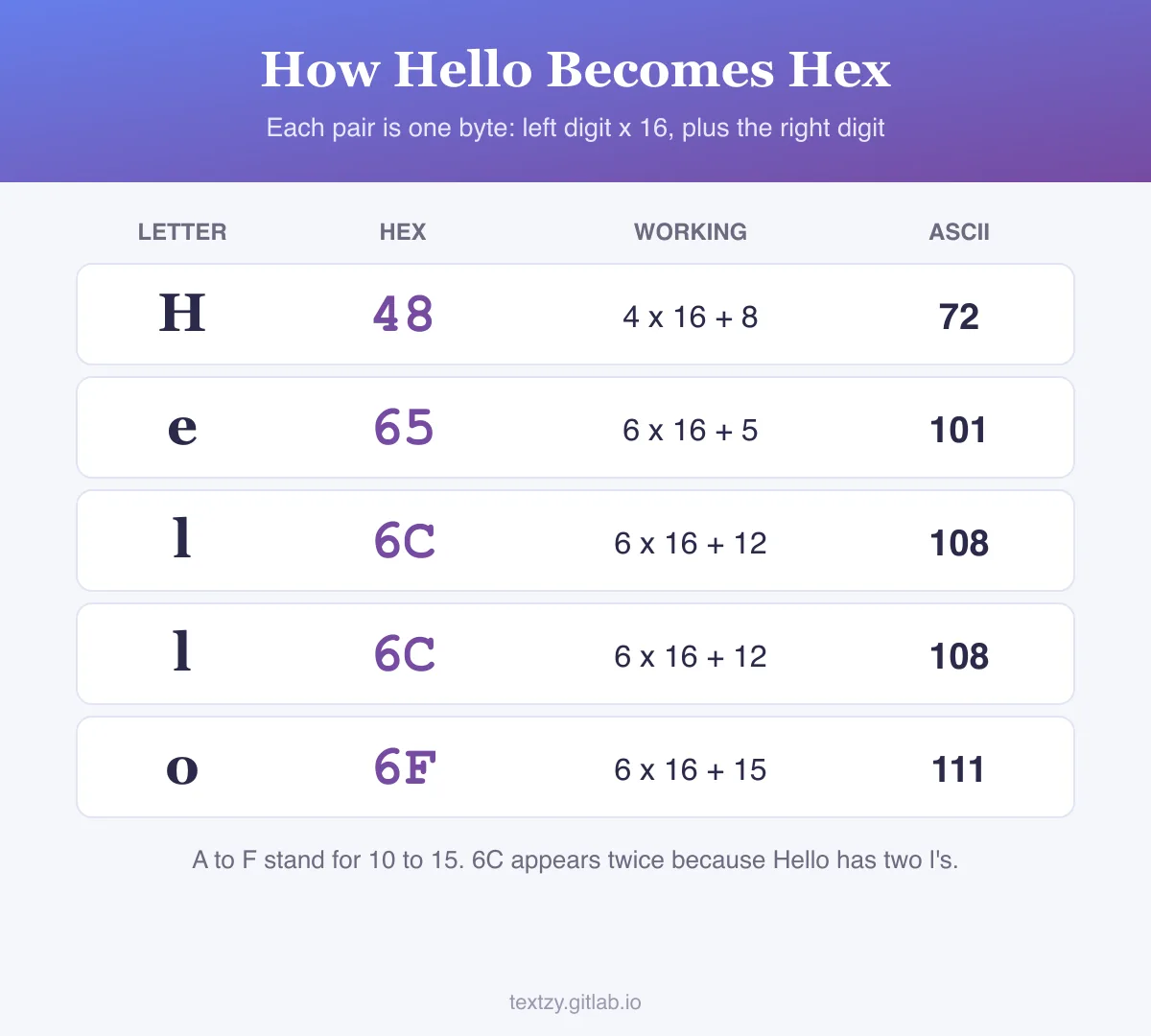
It's read two digits at a time, and each pair is one letter. Hex is what we'd use if people had sixteen fingers. After 9 you'd run out of digits, so it borrows A to F for 10 to 15, and the left digit counts whole sixteens while the right one is the change. So 48 is four sixteens and 8 more, 72 in total, and 72 on the ASCII chart is a capital H. The card below does the whole word, which saves me a page of sums.
The Cafe Problem
Then there's guessing. One box, no switch, so the tool has to work out which way you meant. The lazy rule would be "only hex digits means decode." Then someone types cafe. Or bad. Or face, or beef. Every one of those is legal hex, and every one is also a word somebody types into a box like this on a slow Tuesday.
So the rule got fussier. The rule, in plain words: no number, no decoding. Cafe, bad and face have no 0 to 9 in them, so they stay words. It also wants whole pairs and at least four digits, so a stray "ab" never gets mangled. The 0x that coders stick on the front gets quietly thrown away.
It still guesses wrong sometimes. Type 4bad and it sees two bytes, then hands you a capital K and a broken little box, because the second byte is only half of a longer character. That's the price of no switch. I'd still take it over clicking a toggle every time.
Text in Hex, Straight From the Tool
| Text | Hex |
|---|---|
| A | 41 |
| a | 61 |
| Z | 5A |
| z | 7A |
| 0 | 30 |
| 9 | 39 |
| space | 20 |
| ! | 21 |
| hi | 68 69 |
| Hello | 48 65 6C 6C 6F |
| I love you | 49 20 6C 6F 76 65 20 79 6F 75 |
| é | C3 A9 |
| ❤️ | E2 9D A4 EF B8 8F |
Lowercase lives 20 higher than uppercase. That isn't hex being weird, it's one switch inside the byte flipping on. An é needs two pairs, and a red heart needs six, because your phone secretly glues a black heart to an invisible "make it red" tag. Fill a message with hearts and the hex gets long enough to wrap off the edge of a phone screen.
Paint Chips and Dead Beef
Most people meet hex on a paint chart without knowing it. #FF0000 is red: FF of red, 00 of green, 00 of blue. Nudge it to #FF8800 and the green comes halfway up, and now you've got orange. Designers swap these codes the way builders swap measurements, and a good one can tell you a code is "a sort of muddy teal" without opening anything.
Programmers get the weirder end. Old debugging tools filled empty memory with DEADBEEF, a hex word you can't miss when you're scrolling past at midnight hunting a crash. IBM's System/360 made the habit stick back in 1964, because its eight-bit bytes split neatly into two hex digits. Wikipedia's page on hexadecimal has the long version.
Base 2 more your speed? The Binary Translator does the same job with ones and zeros, and the Morse Code Translator is older than both. A whole cupboard of others sits on the translators page.
Hex, Answered
How do you translate hex to English? Paste it in. On paper you split it into pairs, take the left digit times 16 plus the right one, then find each total on an ASCII chart. Bring tea.
What is hello in hex? 68 65 6C 6C 6F. Give it a capital H and the first pair drops to 48, since capitals sit 20 lower. The other four don't budge.
What does 0x mean in hex? A name tag. 0x41 says hex 41, not forty-one. The tool bins the tag and reads the rest.
Can it convert hex to decimal numbers? Nope, it's text only. 41 comes out as the letter A here, though as a number it's worth 65. Your phone's calculator has a programmer mode for that.
Is hex the same as a hex colour code? Same counting, different job. A colour code is three bytes, one each for red, green and blue, and the # on the front makes this tool treat it as plain text.