Rune Translator
Type English, get Elder Futhark runes to copy. Paste runes, get English.
AI rewrite. Click Translate or press Ctrl/Cmd+Enter. Max 800 characters. Not instant like the word-swap tools.
✨ Works both ways
✨ Reads Viking-age runes too
✨ No signup
About This Rune Translator
Rune converters love to hand you a box of symbols and walk away. This rune translator shows its homework. English goes in and Elder Futhark comes out. The table below lists every swap it made. Runes go in, English comes out. A rune alphabet converter doesn't need a server for that, so the whole thing runs in your browser.
How Do You Translate English Into Runes?
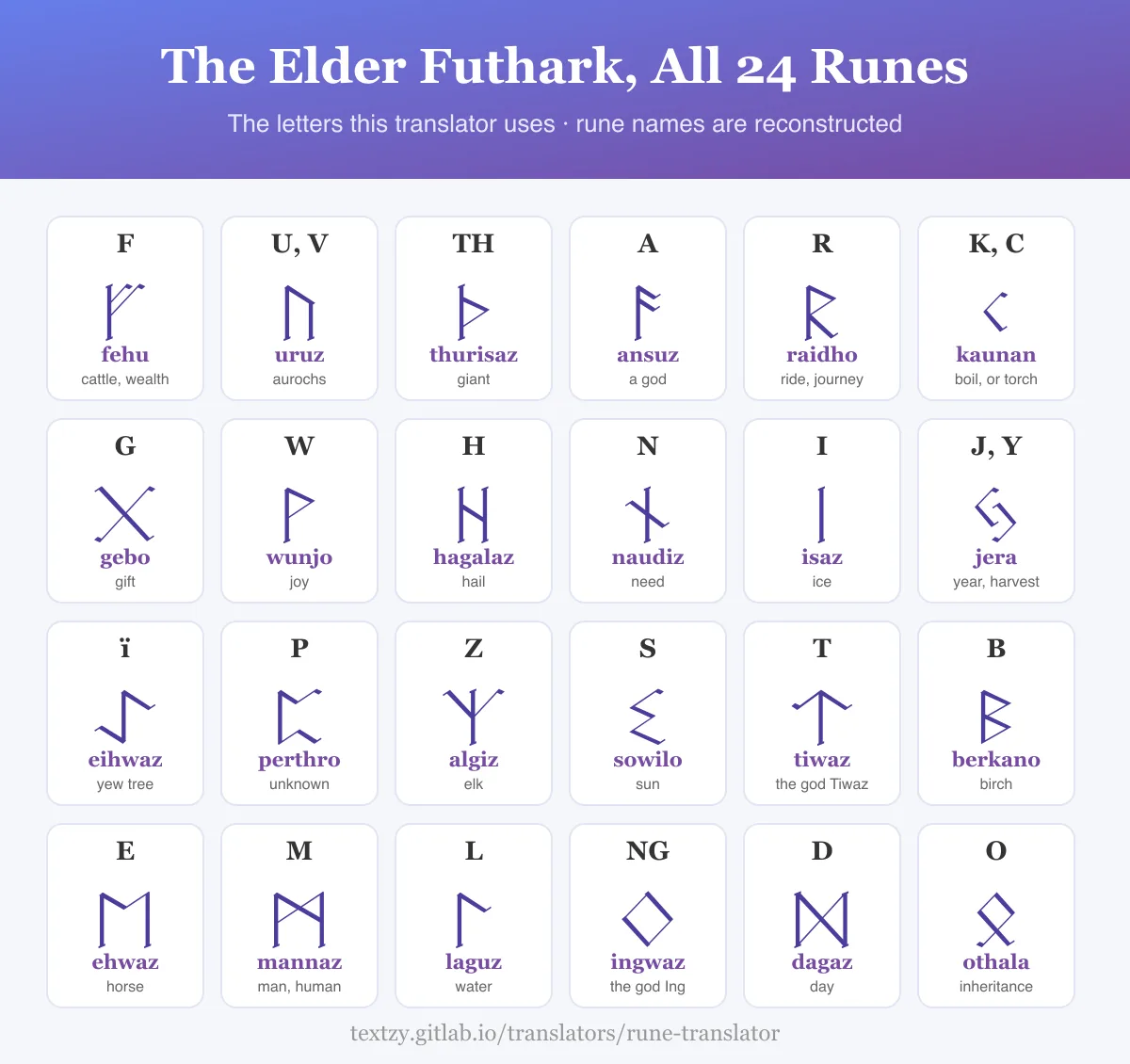
Letter by letter. Twenty-four runes can't cover an alphabet built for another language, so five letters borrow from a neighbor, while TH and NG each get a rune of their own. Every swap is in the table, which comes in handy when a tattoo artist grills you.
| English | Rune | Why |
|---|---|---|
| C | ᚲ | No C rune exists. The K rune does the hard c in cat. |
| Q | ᚲᚹ | Q is K plus W, which is how it sounds. |
| X | ᚲᛊ | X is K plus S. |
| V | ᚢ | There's no V rune either. The Younger Futhark wrote v with the U rune, so the tool does too. |
| Y | ᛃ | The J rune is the y in yes. A vowel y, like the one in my, gets it anyway. |
| TH | ᚦ | Thurisaz, one rune for the th in Thor. |
| NG | ᛜ | Ingwaz, one rune for the ng in king. Before a vowel, as in finger, it stays n plus g. |
Capitals vanish, since runes never had them. Digits and punctuation pass straight through because there's nothing to swap them for. Double letters stay double, which no carver would do. They wrote a single letter, so hello here runs longer than anything you'd find on a stone.
Which Runes Did the Vikings Use?
Not these, strictly, and that's a common mix-up. The Elder Futhark is older, listed as 2nd to 8th century, while Viking Age carvers worked in the Younger Futhark. It cut the alphabet to 16 runes from about the 9th century, so single runes had to cover several sounds, and that's why one carved line can be read two ways. Most "viking runes translator" pages hand you Elder Futhark anyway, this one included. A Viking would have squinted at it. Paste Younger Futhark into the box and it'll still read.
| Younger Futhark rune | Sounds it covers |
|---|---|
| ᚠ | f |
| ᚢ | u, v, w, y, o, ø |
| ᚦ | þ, ð |
| ᚬ | ą, o, æ |
| ᚱ | r |
| ᚴ | k, g, ŋ |
| ᚼ | h |
| ᚾ | n |
| ᛁ | i, e |
| ᛅ | a, æ, e |
| ᛋ | s |
| ᛏ | t, d |
| ᛒ | b, p |
| ᛘ | m |
| ᛚ | l |
| ᛦ | ʀ |
I tried ᚼᛅᚱᛅᛚᛏᛦ ᚴᚢᚾᚢᚴᛦ, my own test line and not a carved one, and the box answered haraltr kunukr, with the t doing the job of a d, which is exactly the squeeze that lets one Viking Age line be read two ways.
Checked Against a Horn From About the Year 400
I ran one line from the Golden Horn of Gallehus through the tool, then held the result up against the runes as Wikipedia prints them. Identical, down to the last ᛉ, which is the kind of check I'd want done before anything goes near a tattoo gun or a wedding ring. The carvers put two dots between words, and the tool doesn't bother, it just leaves spaces.
| Latin letters | Tool output | What it says |
|---|---|---|
| futhark | ᚠᚢᚦᚨᚱᚲ | The first six runes, which is where the alphabet's name comes from |
| ek hlewagastiz holtijaz horna tawido | ᛖᚲ ᚺᛚᛖᚹᚨᚷᚨᛊᛏᛁᛉ ᚺᛟᛚᛏᛁᛃᚨᛉ ᚺᛟᚱᚾᚨ ᛏᚨᚹᛁᛞᛟ | I Hlewagastiz Holtijaz made the horn |
Where It Trips
My first draft of the ng rule was too simple. Singing came out as ᛊᛁᚾᚷᛁᛜ, n and g split apart in the middle, one rune at the end. I fixed that word. Singer still splits, and Thomas still gets the thurisaz rune, which nobody says out loud. Going the other way's blunter. C and K share a rune, so cat returns as kat and family as familj. Mix runes and Latin letters in one string? The box treats it as runes and ignores the letters. Retype it before you trust the answer, because it won't warn you.
Words in Runes, Straight From the Tool
| English | Runes |
|---|---|
| hello | ᚺᛖᛚᛚᛟ |
| Odin | ᛟᛞᛁᚾ |
| Thor | ᚦᛟᚱ |
| Freya | ᚠᚱᛖᛃᚨ |
| Loki | ᛚᛟᚲᛁ |
| viking | ᚢᛁᚲᛁᛜ |
| Valhalla | ᚢᚨᛚᚺᚨᛚᛚᚨ |
| wolf | ᚹᛟᛚᚠ |
| brother | ᛒᚱᛟᚦᛖᚱ |
Where I'd Use It, and Where I Wouldn't
Game handouts, a D&D prop, a name on a wooden gift tag? Fine by me. A tattoo is different, since a mistake there doesn't wash off. Run the runes back through the box first, then show them to someone who reads the script. Real carvers wrote the Norse of their day, so brother above is the English word in runic dress, not bróðir. For genuine Old Norse words, the English to Old Norse Translator is where you'll want to go.
One more thing before any ink. It's about two sowilo runes side by side, ᛊᛊ, which are the lightning bolts of the SS. Any word with a double s, like kiss or boss, ends in exactly that pair.
Into secret alphabets? The Galactic Alphabet Translator does the Minecraft enchanting table. Egyptian next? The Egyptian Hieroglyphics Translator spells names in real signs. Everything else you'll find on the translators page. For the history, the Elder Futhark article on Wikipedia has the full chart.
Rune Questions, Answered
How do you translate English to runes? Type it in the box. Out come Elder Futhark runes, one per letter except th and ng, with a button that copies them.
How do you translate runes to English? Paste them in. Spaces stay put and each rune becomes its letter. Cat doesn't survive the round trip, though, because C and K share a rune. It comes back as kat.
What does Futhark mean? Nothing on its own. It's the first six runes read as a word, which in runes looks like ᚠᚢᚦᚨᚱᚲ.
Are Norse, Nordic and Viking runes the same thing? Close enough for a gift tag, but a museum would object. The 24-rune Elder Futhark is the older script. Viking Age carvers used the 16-rune Younger Futhark. This tool writes the older one and reads both.
What does the Gallehus inscription say? I Hlewagastiz Holtijaz made the horn. The gold horn dates to around 400, and the longer one turned up on 20 July 1639, with the shorter one found on 21 April 1734. Then on 4 May 1802 a goldsmith named Niels Heidenreich nicked both and melted them down for the metal.
Does it work for Anglo-Saxon runes? Half. Writing is Elder Futhark only. Reading is looser, so a futhorc rune like ᚪ or ᛠ comes back as a or ea.