English to Ancient Greek Translator
Real lines from Delphi, Homer and the Gospels, in Greek letters, with a Say it line underneath. Every other word is checked in Wiktionary's Ancient Greek dictionary.
AI rewrite. Click Translate or press Ctrl/Cmd+Enter. Max 800 characters. Not instant like the word-swap tools.
✨ Real Greek lines
✨ Say it in Latin letters
✨ No AI guessing
About This English to Ancient Greek Translator
Greek tattoos go wrong a lot. Missing accents, modern spellings, the odd letter that isn't Greek at all. So this English to Ancient Greek translator has no AI in it. Every word comes from Wiktionary's Ancient Greek dictionary, 69,171 entries the day I counted, 24 October 2026. Famous lines come out exactly as they were written at Delphi, by Homer, in the Gospel of John. Under each one sits a Say it line in our letters, no alphabet lessons needed.
How Do You Say Know Thyself in Ancient Greek?
Γνῶθι σεαυτόν. Gnōthi seauton. Two words. Know, as an order, and yourself. It was carved at Apollo's temple in Delphi, which is a funny thing to read on your way in to ask a god whether you should marry the neighbor's daughter or invade Sicily. Type know thyself and those two words come back, breathing marks and all.
Famous Lines, Spelled the Way the Greeks Wrote Them
Copy-paste lists online love to lose the little marks, and these keep every one. The tool adds a Say it line under each one when you translate.
| English | Ancient Greek | Where it's from |
|---|---|---|
| Hello | Χαῖρε | Everyday greeting |
| Goodbye | Ἔρρωσο | Letters and farewells |
| How are you? | Τί πράσσεις; | Everyday greeting |
| I love you | Φιλῶ σε | Built from checked forms |
| Thank you | Χάριν οἶδά σοι | Built from checked forms |
| Know thyself | Γνῶθι σεαυτόν | Temple of Apollo, Delphi |
| Nothing in excess | Μηδὲν ἄγαν | Temple of Apollo, Delphi |
| Come and take them | Μολὼν λαβέ | Leonidas, via Plutarch |
| Make haste slowly | Σπεῦδε βραδέως | Old proverb |
| I have found it | Εὕρηκα | Archimedes |
Molōn labe ends up on gym shirts and truck bumpers. Leonidas, Thermopylae, a Persian king wanting the Spartans' weapons. Two words back: come and take them. Funny detail: we only have it from Plutarch, writing nearly six hundred years later, so it's a quote of a quote that somebody's now wearing to leg day.
What Went Wrong While I Built It
First thing that broke was a shortcut I'd made for the opening of John's gospel. You'd type the chapter and verse, the way it's printed in a Bible, and I typed exactly that and got <john> back. The tool throws out numbers and colons before it looks anything up, so my clever shortcut never had a chance. Gone. Type in the beginning was the word instead, or paste the Greek.
Thank you took longer. No fixed Greek phrase for it, oddly. Closest everyday way: χάριν οἶδά σοι, I know grace to you, more or less I owe you one. Not a quote. Three checked forms stuck together. Better that than slapping ευχαριστώ on it, which is modern Greek wearing a toga and hoping nobody in the museum gift shop line notices the difference.
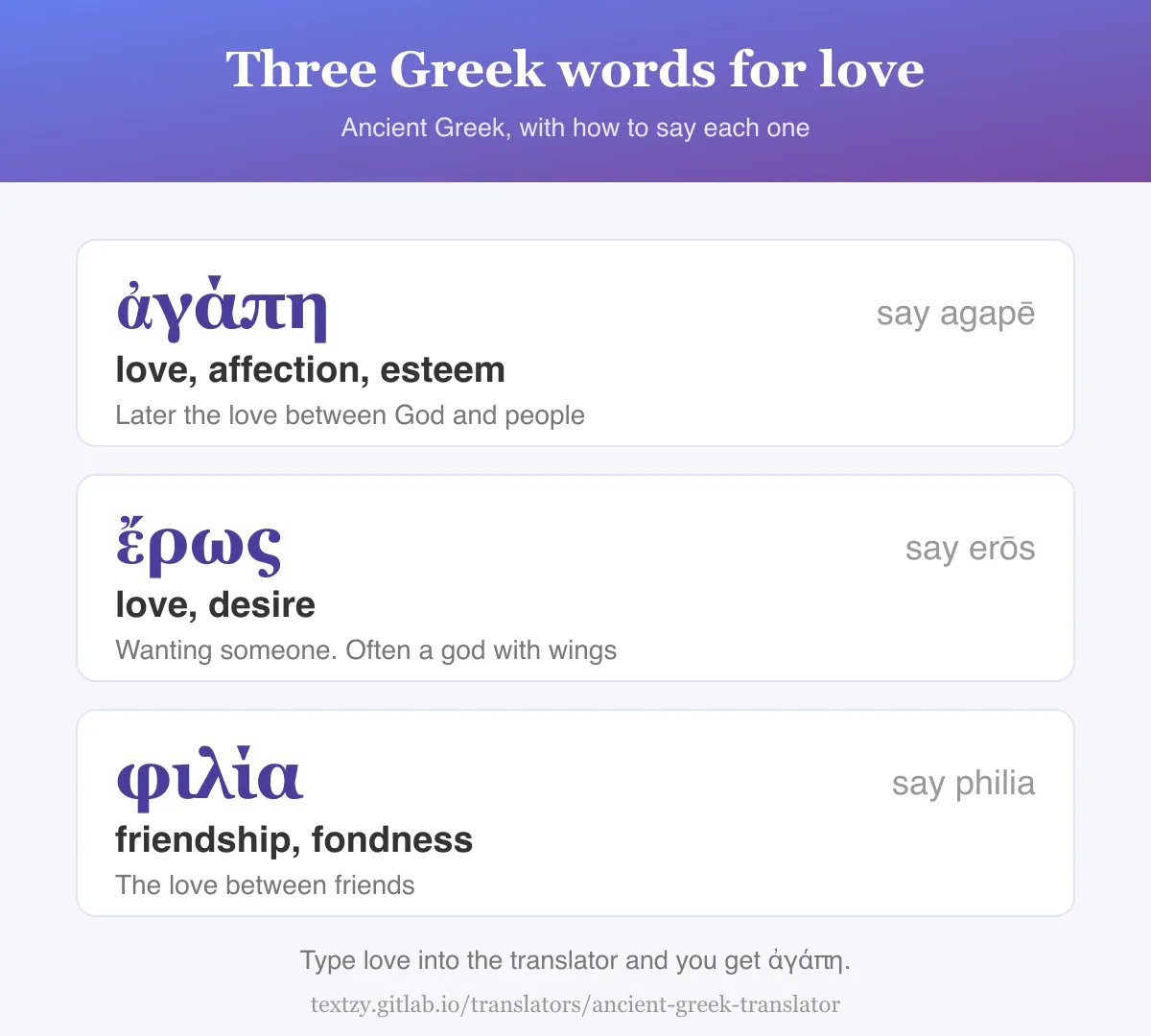
Greek won't give you one word for love. Ἀγάπη, the steady kind, the one the New Testament picks for God. Ἔρως, wanting someone. Φιλία, mates. Plain love in the box gets you ἀγάπη. Mean the other two? Check the card. Sending ἔρως to your gran on her birthday is a choice, and it's one you'll be explaining at every family dinner for the rest of the year.
| English | Ancient Greek |
|---|---|
| Soul | Ψυχή |
| Word, reason | Λόγος |
| Wisdom | Σοφία |
| Virtue | Ἀρετή |
| Happiness | Εὐδαιμονία |
| Truth | Ἀλήθεια |
| Hope | Ἐλπίς |
| Freedom | Ἐλευθερία |
| Chaos | Χάος |
| Order, world | Κόσμος |
| Fate | Μοῖρα |
| Immortal | Ἀθάνατος |
Anything the phrasebook hasn't got comes back word by word, in your order, with a warning attached. Try my friend is happy and you'll see ἐμός φίλος εἰμί εὐδαίμων. Real words, wrong shape. A Greek teacher would rewrite half of it in red pen, so don't ink that one until somebody who actually reads Plato has had a look at it over coffee.
Attic, Koine and Homer
Three Greeks live in here. Plato's Attic. The Koine of the New Testament, which is why John 1:1 made the cut. Homer's, older and stranger, padded with extra syllables so the lines keep their beat when a singer's halfway through a battle scene and running out of breath. Plain dictionary words lean Attic, same as most school courses.
Χ is k with a puff, kh. Φ, ph. Θ, th. Η and ω get a bar on top in Say it because they're long.
Vikings more your thing? The English to Old Norse Translator. Westeros? The High Valyrian Language Translator. The rest of the old and made-up tongues hang out on the translators page, and every Greek word here traces back to Wiktionary's Ancient Greek dictionary.
Ancient Greek, Answered
Can Google Translate do Ancient Greek? No. Modern Greek only. Paste Plato in and it reads him like this morning's paper from Athens. Alphabet right, plenty else wrong.
How do you say hello in Ancient Greek? Χαῖρε, khaire. Literally rejoice. Works as goodbye too. A whole room? Χαίρετε.
How do you say I love you in Ancient Greek? Φιλῶ σε, philō se. I love, you. Built from checked forms, since no famous line says it outright, which surprised me too.
Is Ancient Greek the same as modern Greek? Same alphabet, different language in a lot of ways. In 1982 Greece dropped the breathing marks and all but one accent, and Greek schoolkids still take the old language as a separate subject.
What is Koine Greek? The Greek everybody spoke around the Mediterranean after Alexander. The New Testament's in it. John 1:1 opens Ἐν ἀρχῇ ἦν ὁ λόγος, in the beginning was the Word, and the tool gives you the whole verse.
What is the most accurate Ancient Greek translator? For famous lines? One that copies the sources letter for letter. This one does. New sentences? Anything that adds endings is guessing. This one hands you checked dictionary words and says so.