English to Katakana Translator
Type a name or an English word for katakana. Paste katakana to read it. Hiragana swaps over too.
AI rewrite. Click Translate or press Ctrl/Cmd+Enter. Max 800 characters. Not instant like the word-swap tools.
✨ Real loanword spellings
✨ Converts your name
✨ Hiragana to katakana
About This Katakana Translator
Our English to katakana translator has a list of the words Japan really uses, since no one can get coffee from its English letters alone. Type coffee and you'll get the real spelling, not a robot guess. Past that, it sounds out your word. Katakana in? Romaji out.
How Do You Write Your Name in Katakana?
Type it in. I'd guess that's why most of you came, so more than 80 common names sit in my list with the spelling a Japanese friend would write. Rare names get sounded out, and since Japan respells a foreign name by ear, two friends might write the same rare name in slightly different ways without either one being wrong.
| Name | Katakana | Sounds like |
|---|---|---|
| John | ジョン | jon |
| Mary | メアリー | mearī |
| Michael | マイケル | maikeru |
| Emily | エミリー | emirī |
| David | デイビッド | deibiddo |
| Sarah | サラ | sara |
| Chris | クリス | kurisu |
| Jessica | ジェシカ | jeshika |
| Ashley | アシュリー | ashurī |
| Kevin | ケビン | kebin |
Expect a longer name. Japanese wants a vowel after nearly every consonant. K at the end grows a ku. T grows a to. Mike ends up with three sounds where English has one beat. There's no l either, so Emily's l borrows the r row.
Why Does Coffee Look So Odd in Katakana?
Because Japan got these words by ear, and often from people who weren't English at all. Coffee went through Dutch. Bread is pan, from the Portuguese pão. Germany is doitsu, from a Dutch word again. No spelling rule on earth finds those, which is why I stopped trying and wrote a list.
| English | Katakana | Romaji |
|---|---|---|
| coffee | コーヒー | kōhī |
| beer | ビール | bīru |
| ice cream | アイスクリーム | aisukurīmu |
| hamburger | ハンバーガー | hanbāgā |
| computer | コンピューター | konpyūtā |
| Christmas | クリスマス | kurisumasu |
| America | アメリカ | amerika |
| bread | パン | pan |
| Germany | ドイツ | doitsu |
| dragon | ドラゴン | doragon |
| hello | ハロー | harō |
| thank you | サンキュー | sankyū |
| television | テレビ | terebi |
That list is short, I'll admit. Katakana isn't quite translation, either. Write dragon in it and a Japanese reader will get it. Whole sentences? Try the English to Romaji Translator.
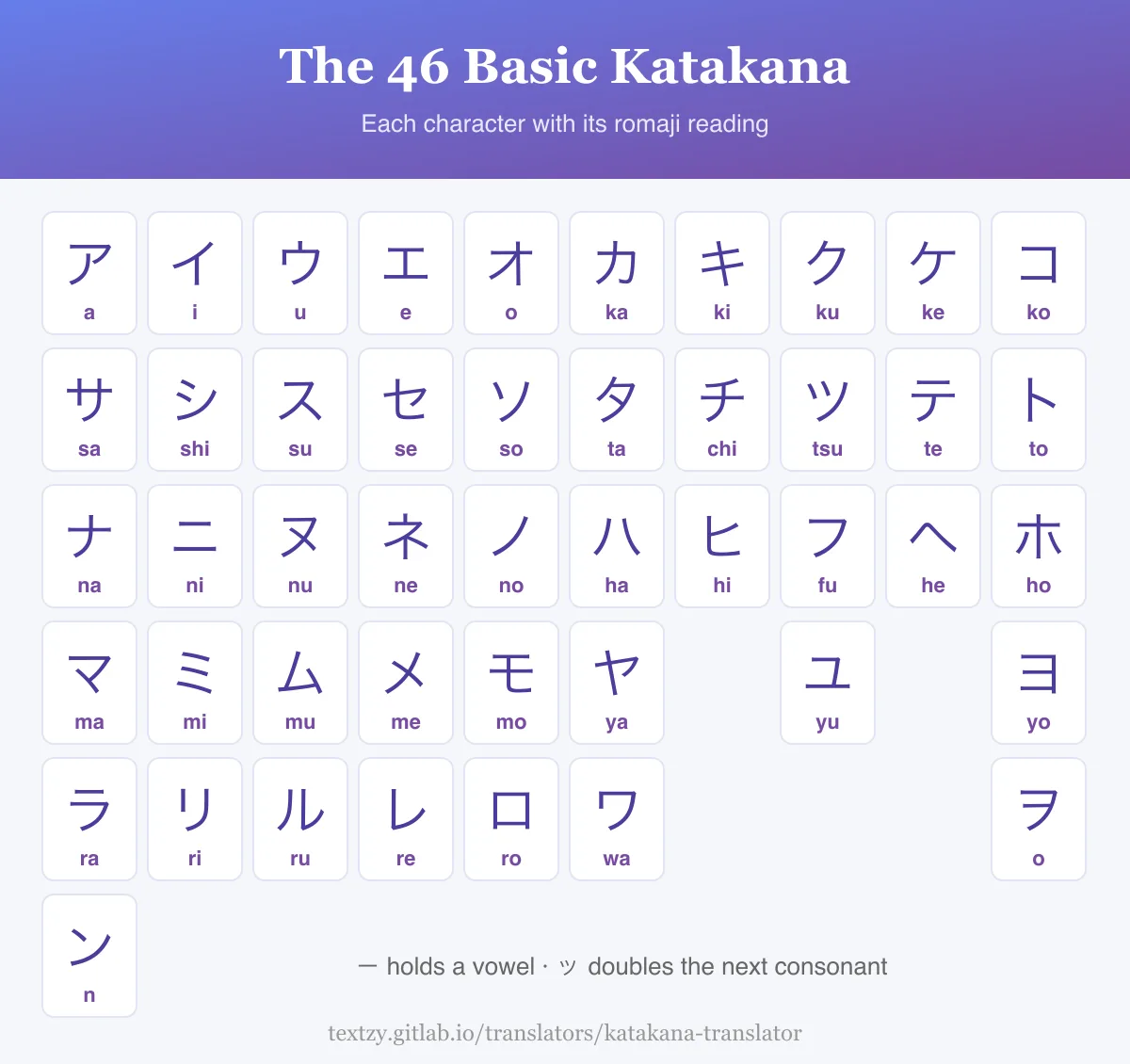
Katakana to English, Sort Of
You'll get Hepburn romaji with the long vowels marked. On my list? Then the English tags along, so the coffee word gives kōhī (coffee). Old half-width forms get fixed first. Tokyo in katakana reads tōkyō and stops there. Kanji just sits in the output, untouched, because I'd rather hand it back than guess, and there's no AI here to guess with, only rules and a word list that I typed out myself.
Hiragana to Katakana in One Step
The two sets sit one Unicode block apart, so this swap's perfect every time. Romaji in Latin letters works too, so konnichiwa comes out right. After hiragana instead? There's a Hiragana Translator for that.
How I Broke It
My first sound-out rules were bad. The table has the proof, and the top two rows are real first-run output.
| Word | What came out | What Japan writes |
|---|---|---|
| name (first try) | ンエイム | ネイム |
| Grace (first try) | グルエイク | グレイス |
| cup (still wrong) | クップ | カップ |
| Hunter (still wrong) | フンター | ハンター |
Name opens on a sound no Japanese word starts with. Grace somehow grew a k. So out went the rules, and now English turns into rough sounds first and kana next. That fix would wreck sayonara, since the rule reads ay as the a in day. Now the code tests each word first, and if it fits as Japanese syllables it stays romaji, but if it looks like Jake the English rules take it. New words can still miss. Cup and Hunter fail because English u often sounds like the Japanese a, and my rules read it as u, which gave me ku for cup when every menu in Tokyo says ka. English u beat me. Check an unknown word with someone who reads Japanese before it goes on a shirt, because that shirt will outlive your interest in anime and I won't be there to apologize for it.
A nickname for a game profile? Fine. A rubber stamp? Also fine. A pen name on a manga-style poster? Go for it. A tattoo's another matter, since one wrong character stays on your arm for life and any Japanese reader on the beach will spot it.
Into odd alphabets? Russian's over at the Cyrillic to English Translator. Want the history? Wikipedia's Katakana article has it. More tools? The translators page.
Katakana Questions, Answered
What is katakana used for? Imports, mostly. My list has coffee, hamburger and Christmas, and you'll spot the same script on manga sound effects.
How do I convert English to katakana? Type it. If it's on my list, you'll get the spelling Japan prints. Off the list, you get my sound-out, so don't print it yet.
How do you translate katakana to English? Paste it. You always get romaji, and English tags along for list words like coffee.
What's the difference between hiragana and katakana? Sound, none. Hiragana's the home team, katakana's the visitors, and only the shapes differ.
What does the long dash in katakana mean? Hold the vowel. Say ko-hi in a Kyoto cafe and you've said nothing. Say ko-o-hi-i and you'll get a cup.
Can it convert kanji to katakana? No. One kanji has several readings, the right one hangs on its neighbors, and my code doesn't read neighbors.