Shakespearean Translator
Type modern English for thou and thee. Paste Shakespeare to read it plain.
AI rewrite. Click Translate or press Ctrl/Cmd+Enter. Max 800 characters. Not instant like the word-swap tools.
✨ Works both ways
✨ Real thou and thee grammar
✨ No AI guessing
Advertisements
Advertisements
About This Shakespearean Translator
Juliet's not looking for Romeo. "Wherefore art thou Romeo?" asks why, as in why'd he have to be born a Montague, and plenty of us read it wrong out loud in Year 9. This Shakespearean translator won't. It runs on rules I checked against the plays, both ways round: modern English in, thou and thee out, or Shakespeare in and plain English out.
Cream-faced loon is Macbeth yelling at a servant, by the way. That one and 39 more, with act and scene, sit on the Shakespeare Insult Generator.
What Does Shakespearean English Sound Like?
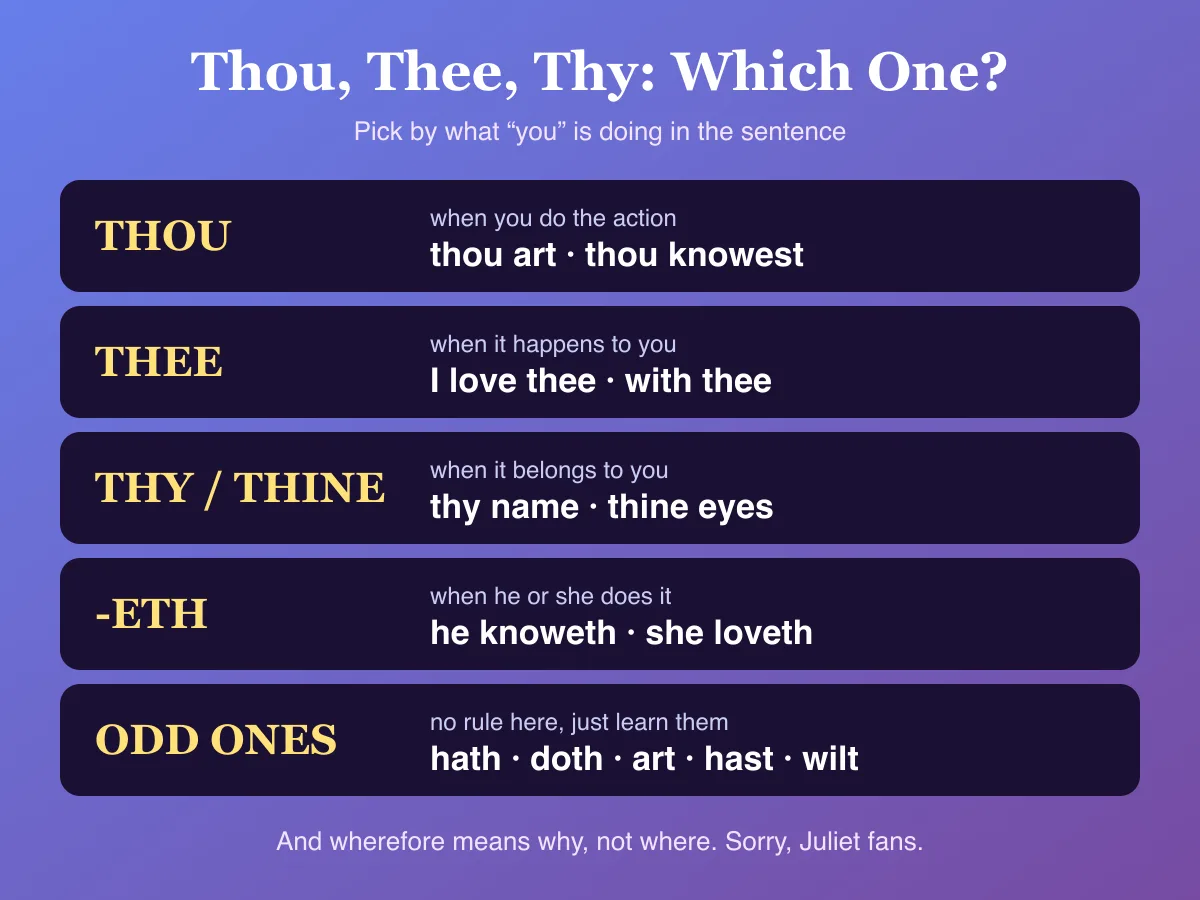
It's ordinary English with older pronouns and verb endings. You turns into thou when it does the action and thee when it gets acted on. Verbs after thou grow an -est, so you know turns into thou knowest. Verbs after he or she take -eth. Questions flip round: knowest thou him? That trio covers most lines you'll ever need. The leftovers are small words, ere for before, prithee for please.
| Modern English | Shakespearean | The rule |
|---|---|---|
| you are my friend | thou art my friend | You doing the action is thou |
| I love you | I love thee | You on the receiving end is thee |
| your eyes | thine eyes | Thine before a vowel, thy before the rest |
| do you know him? | knowest thou him? | No do in questions, verb first |
| he knows | he knoweth | -eth after he, she and names |
| she has a cat | she hath a cat | Has, does and says go hath, doth, saith |
| I don't know | I know not | Not goes after the verb |
| it is late | 'tis late | It is squeezes into 'tis |
| why are you sad? | wherefore art thou sad? | Wherefore means why |
| where are you going? | whither goest thou? | Whither means to where |
| I want to go home | I would fain go home | Fain means gladly |
| please wait | prithee wait | Prithee is I pray thee, squashed |
What Broke While I Built It
First casualty: Macbeth. "Is this a dagger which I see before me?" went in as a test, since real Shakespeare should come out untouched. No thou, no hath. My detector shrugged, called it modern and swapped before for ere. Ere means earlier, though. Ere dark, fine. Ere me? Any drama teacher would wince, and a kid handing that in would lose marks for something a tool did. Now before stays put when me, him or the comes next.
"I know not" fooled it too. No thou, no hath, no -eth, so it looked modern and came back unchanged. These days a verb with not after it counts as a sign of Shakespeare, and it comes back as I don't know.
Want was the sneaky one. In the plays it often means lack, so "I want money" would read as a confession that you're broke, which isn't what you typed and isn't what you'd want in a birthday card. I swap it for would fain or desire instead.
Thou or You? Shakespeare Picked on Purpose
Thou wasn't just the old word for you. Both were in use, and choosing one sent a message. Thou was for people close to you or below you, like a child or a servant. Aimed at an equal, it could sting. You was the polite one, and the plural too, so a room full of people always got you. Hamlet, act 3. His mother: "thou hast thy father much offended." Him: "you have my father much offended." That cold you is the knife, since he means his dead dad and she means her new husband. Wikipedia's page on thou has the long story of how it vanished from everyday English.
This tool uses thou every time, since that's the sound people come here for, whether it's a birthday card for a theatre nerd or a group chat that's gone full Elizabethan. If you're writing a speech to a king for a school play, swap a few back to you by hand so the courtiers don't sound like they're picking a fight. It'll read more polite, and more correct.
Shakespearean Isn't Old English
People mix these up all the time, and fair enough, since plenty of us grew up calling anything with a thou in it Old English and nobody ever corrected us. Shakespeare wrote in Early Modern English, which you can read today with a bit of squinting. Old English is the Beowulf stuff. It's a thousand years older and looks like a different language. Want the fun fake-olde look with ye and -eth on everything? That's the Old English Translator. The Early Modern English Translator goes word by word, with stock phrases like "how farest thou."
Shakespearean Translator Questions
How do I translate English to Shakespearean? Type your sentence in the box. Thou and thee get sorted by who's doing what, verbs pick up -est or -eth, and questions flip round. Keep it to a line or two. Paragraphs work, but a long run-on sentence can trip the thou rules.
Can it translate Shakespeare to modern English? Yes, it flips direction by itself. Drop in anything with thou, hath or 'tis, and knowest thou him comes back as do you know him. Hamlet's soliloquies? Less luck. "Slings and arrows of outrageous fortune" has no thou in it to fix, so grab a study guide for those.
Does wherefore mean where? Nope, why. She's asking why he has to be Romeo, a Montague, from the family hers is at war with. For where, Shakespeare mostly just wrote where. Whither was where to. Whence was where from. Nobody in the plays mixes them up, only us.
Is this Shakespearean translator AI? No AI. Every swap is a rule I wrote by hand. Type the same sentence twice, get the same line twice. Anything off my list passes through untouched, so you won't get a made-up word that sounds old and means nothing.
How do you say hello in Shakespearean? Good morrow works any time before evening, so it's the safe pick for a morning text to a friend who just got cast in the school play. After lunch it's good even. Leaving? Fare thee well. Skip hail unless your friend is wearing a crown.
What does prithee mean? Please. It's I pray thee squashed into one word, the same way goodbye started as God be with you.