Aramaic Translator
Bible lines checked letter by letter. Three ways to read every result.
AI rewrite. Click Translate or press Ctrl/Cmd+Enter. Max 800 characters. Not instant like the word-swap tools.
✨ Peshitta lines
✨ Syriac and Hebrew letters
✨ No AI guessing
Advertisements
Advertisements
About This Aramaic Translator
Shlama. Hello and peace, same word. This Aramaic translator won't make up a thing. Plenty of sites feed English to an AI, get squiggles back and call it ancient. Fine for a laugh. Not fine on your forearm. So I took another road. The lines here come from the Peshitta. That's the old Syriac Bible, and I matched them letter by letter against the text. Single words come from a checked dictionary. You type English, you get two alphabets and a line for your mouth. Paste Aramaic and English falls out.
How Do You Say Hello in Aramaic?
Shlama, ܫܠܡܐ on paper. Say it next to shalom and salaam and you'll hear the family. Everything on this list runs backwards as well. Drop in the Syriac, get the English.
| English | Aramaic | Say it |
|---|---|---|
| Hello, peace | ܫܠܡܐ | shlama |
| Thank you | ܬܘܕܝ | tawdi |
| Father | ܐܒܐ | abba |
| God | ܐܠܗܐ | alaha |
| Peace be with you | ܫܠܡܐ ܥܡܟܘܢ | shlama amkhon |
| God is love | ܐܠܗܐ ܚܘܒܐ ܗܘ | alaha hubba hu |
| I love you | ܪܚܡ ܐܢܐ ܠܟ | rahem na lakh |
| Our Father in heaven | ܐܒܘܢ ܕܒܫܡܝܐ | abun d'bashmayo |
| Thy kingdom come | ܬܐܬܐ ܡܠܟܘܬܟ | tethe malkuthakh |
| Amen | ܐܡܝܢ | amin |
| Messiah | ܡܫܝܚܐ | mshiha |
| Holy Spirit | ܪܘܚܐ ܕܩܘܕܫܐ | ruha d'qudsha |
One warning on I love you. Aramaic verbs change with who's talking and who's listening, so that line is a man speaking to a man. A woman speaking, or a man speaking to a woman, would need a slightly different form, and I don't have a checked line for those yet, so I left them out. It's also the one in the table I built from dictionary words, along with Holy Spirit. The rest are single entries or Bible text. Twelve short lines I'd defend in a pub beat a whole paragraph of squiggles nobody here can read, and that's the deal with this page, take it or leave it.
What Did Jesus Say in Aramaic?
Not much. The Greek gospels left a few of his lines in Aramaic, and those are what folks come here for. Talitha koum, to a dead girl. Ephphatha, to a deaf man. Eloi, Eloi, from the cross. Spell them any old English way and out pops the Syriac from that verse, koum or cumi. Back then you could haggle in Aramaic from Egypt to Persia. It was the English of its day. Greek and later Arabic pushed it out of the big towns over time, but it hung on in the hills and in church, and it's hanging on there still.
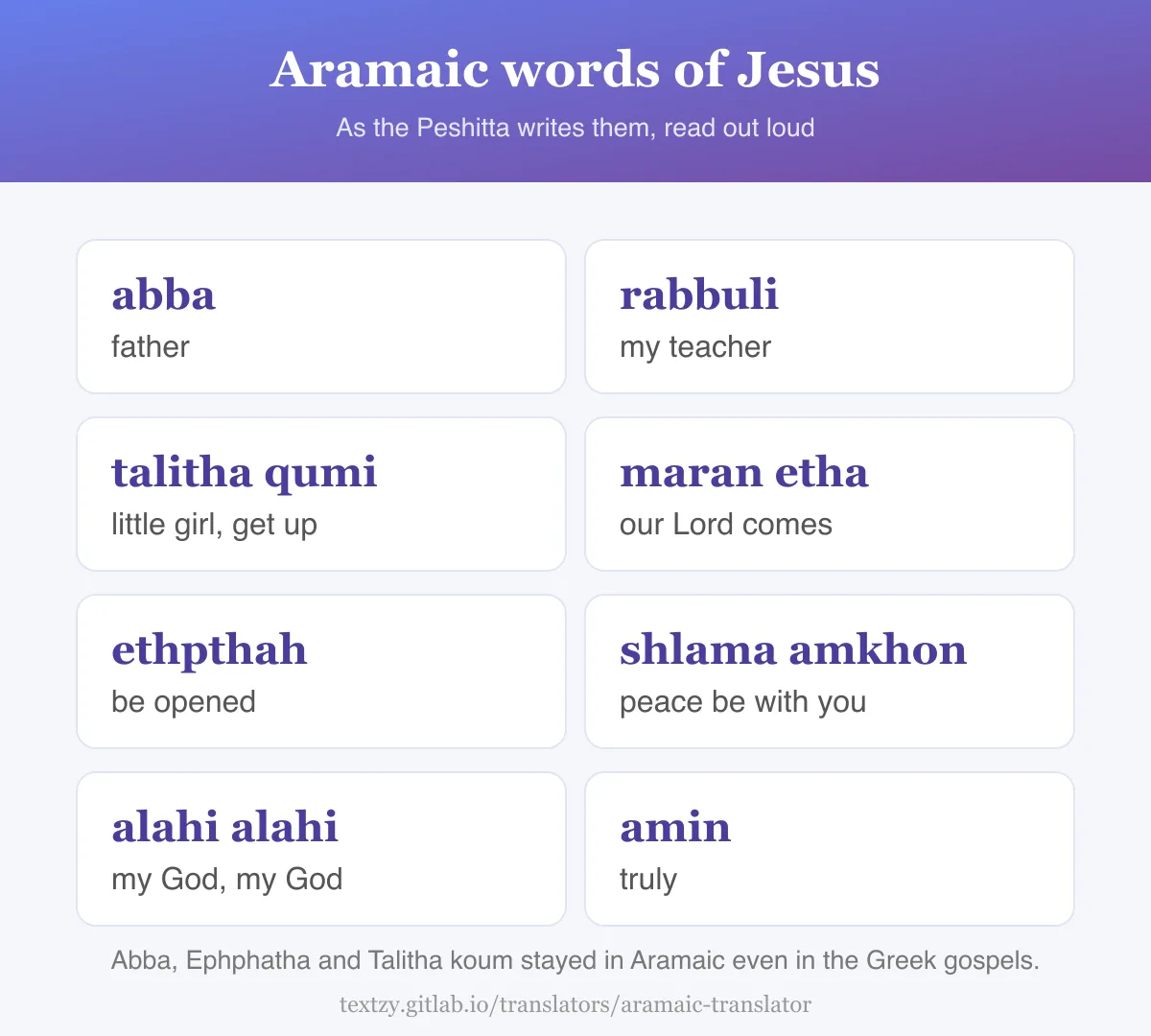
Honest catch: Syriac is not what Jesus spoke. He'd have used a Galilean dialect, and nobody wrote that one down the way Edessa wrote down Syriac a few hundred years later. Close cousin, though. Twenty-two letters both ways, a lot of shared words, another accent. It's the nearest full text I can check, so I built on it. Guessing at something older and calling it authentic is how bad tattoos happen. Priests in Iraq, Syria and Turkey still chant this stuff on Sundays, so none of it is a museum piece, even if you won't get far ordering a coffee with it.
Why Are There Two Alphabets Here?
They're both Aramaic, believe it or not. Syriac's the flowing one churches still write. The square one people call Hebrew letters? Aramaic too, picked up by Jews after the exile. Right to left, one letter for one letter, so you get both every time. Paste either and it reads. Ask a Syriac monk and a rabbi to write the same word and they'll use different shapes for the same sounds, then probably argue over who had it first. Empty boxes where the Syriac ought to be? Your phone's short a font, that's all, and the Hebrew line plus the Say it line still turn up fine underneath, so you're not stuck. Latin spelling works as well for known words, so shlama or malka will get you there.
Sentences are where it gets rough, and I'd rather say so. Anything off the phrasebook gets looked up one word at a time, verbs stuck in base form. My and your? Word endings in Aramaic, so angle brackets. Punch in my son and you'll see son land fine while my sits in its brackets, sulking, waiting for an ending nobody gave it. Same brackets for whatever the dictionary hasn't got. Call it a sketch. Skin-bound? Find a Syriac priest or a scholar first. I'd feel better. If you're here for a tattoo, pick a short line from the table and bring the Hebrew letters along too, since your artist is far more likely to have seen those than Syriac, and a short line leaves less room for a slip of the needle.
Old languages are a bit of a habit around here. The Ancient Greek Translator is built like this one, and the Old Norse Translator too. Want the verses? Dukhrana Peshitta lays out every chapter in Syriac for nothing.
Aramaic, Asked and Answered
Is Aramaic still spoken? Yes. Assyrian and Chaldean communities speak modern forms today, and so do a few villages in Syria, Maaloula being the famous one. Those forms differ a lot from the Syriac here.
What language did Jesus speak? Aramaic, day to day. He'd likely have known Hebrew from scripture too, and maybe some Greek for trade, but his quoted words are Aramaic.
Is Aramaic in Google Translate? No. I went through its language list on 1 November 2026. No Aramaic, no Syriac. So whatever you saw online, Google didn't do it.
Is Aramaic the same as Hebrew? No. Sisters, the way Spanish and Italian are. Abba and shlama ring a bell, but a Hebrew reader won't follow a whole page without help.
How do you read Aramaic? Right to left, mostly consonants. Vowels are left out or added as tiny dots, so the Say it line does that job for you.
Can it translate full sentences? Only roughly. Known lines come out exact, and anything else gets dictionary words in order, so it's a starting point and not finished Aramaic.